
Updated on 2026/05/22

Information


写真a

 
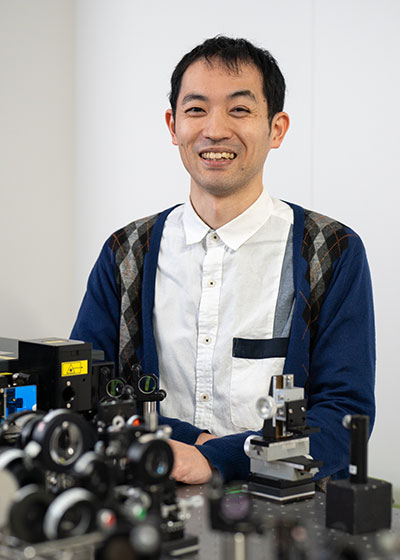
MIYATA KIYOSHI
 
バナー付きURL

Video URL
Organization
Faculty of Science Department of Chemistry Associate Professor
School of Sciences Department of Chemistry(Concurrent)
Graduate School of Sciences Department of Chemistry(Concurrent)
Research Center for Negative Emissions Technologies Ubiquitous Light Energy Research Division(Concurrent)
Center for Molecular Systems (CMS) (Concurrent)
Title
Associate Professor
Contact information

メールアドレス
Profile
The researcher is interested in photo-carrier dynamics in organic solids or organic-inorganic semiconductors using ultrafast spectroscopy.

Research Areas

  • Nanotechnology/Materials / Analytical chemistry

  • Natural Science / Semiconductors, optical properties of condensed matter and atomic physics

  • Nanotechnology/Materials / Inorganic materials and properties

  • Natural Science / Semiconductors, optical properties of condensed matter and atomic physics

  • Nanotechnology/Materials / Fundamental physical chemistry

  • Nanotechnology/Materials / Functional solid state chemistry

  • Nanotechnology/Materials / Fundamental physical chemistry

  • Nanotechnology/Materials / Optical engineering and photon science

  • Nanotechnology/Materials / Functional solid state chemistry

  • Natural Science / Biophysics, chemical physics and soft matter physics

▼display all

Degree

  • PhD of Science

Research History

  • Kyushu University Department of Chemistry, Graduate School of Science Associate Professor 

    2022.12 - Present

      More details

    Country:Japan

  • Kyushu University Faculty of Sciences, Department of Chemistry Associate Professor 

    2022.12 - Present

      More details

    Country:Japan

    researchmap

  • Kyushu University Department of Chemistry, Graduate School of Science Assistant Professor 

    2018.2 - 2022.12

      More details

    Country:Japan

  • Kyushu University Faculty of Sciences, Department of Chemistry Assistant Professor 

    2018.2 - 2022.12

      More details

  • Columbia University Department of Chemistry Academic Researcher 

    2016.4 - 2018.1

      More details

    Country:United States

  • Columbia University Department of Chemistry Academic Researcher 

    2015.4 - 2018.1

      More details

    Country:United States

▼display all

Education

  • Kyoto University   Graduate School of Science  

    2011.4 - 2015.3

      More details

    Country:Japan

    Notes:Doctor course

  • Kyoto University   Graduate School of Science   Department of Chemistry

    2009.4 - 2011.3

      More details

    Country:Japan

  • Kyoto University   Fuculty of Science  

    2005.4 - 2009.3

Research Interests・Research Keywords

  • Research theme: 光励起状態ダイナミクス

    Keyword: 光励起状態ダイナミクス

    Research period: 2026

  • Research theme: 光機能性材料

    Keyword: 光機能性材料

    Research period: 2026

  • Research theme: 分子科学

    Keyword: 分子科学

    Research period: 2026

  • Research theme: Ultrafast Spectroscopy

    Keyword: Ultrafast Spectroscopy

    Research period: 2026

  • Research theme: 分光分析

    Keyword: 分光分析

    Research period: 2026

  • Research theme: 有機エレクトロニクス材料

    Keyword: 有機エレクトロニクス材料

    Research period: 2026

  • Research theme: 有機無機ハイブリッド材料

    Keyword: 有機無機ハイブリッド材料

    Research period: 2026

  • Research theme: Physical Chemistry

    Keyword: Physical Chemistry

    Research period: 2026

  • Research theme: Development of Novel Spectroscopic Analysis Methods Using Flow Chemistry

    Keyword: フロー化学、分析化学、光化学

    Research period: 2024 - Present

  • Research theme: Elucidation of mechanisms of photoinduced chemical processes using metal complexes

    Keyword: Artificial photosynthesis

    Research period: 2019.4

  • Research theme: Exciton dynamics in lanthanide metal/ions

    Keyword: lanthanide

    Research period: 2018.4

  • Research theme: Structural dynamics of thermally assisted delayed fluorescence molecules

    Keyword: Thermally Assisted Delayed Fluorescence

    Research period: 2018.2

Awards

  • 第15回分子科学会奨励賞

    2022.9   分子科学会   超高速分光を利用した有機光機能性材料の電子・構造ダイナミクスと機能発現メカニズムの研究

     More details

  • 分子科学会奨励賞受賞

    2022.9   分子科学会   超高速分光を利用した有機光機能性材料の電子・構造ダイナミクスと機能発現メカニズムの研究

     More details

    分子科学会から超高速レーザーを利用した材料科学の研究が評価され、受賞に至った。

  • 令和2年度 文部科学大臣表彰(若手科学者賞)

    2020.4   文部科学省   新規有機光機能性材料の光励起ダイナミクスの研究

     More details

    現在の半導体産業は無機半導体を用いたデバイスをベースに発展しているが,従来の限界を超えた応用可能性(低コスト製造や大面積化など)をもとめて有機分子を構成要素として含む新規材料,有機半導体や有機無機ハイブリッド半導体の開発も進められている.しかし,これら新奇半導体では従来の理論で説明できない物性が多数観測されており,特殊な電子物性の起源解明は応用研究・基礎研究双方から重要である.申請者は,様々な分光法,特に超短パルスレーザー分光を駆使して電子物性・光化学過程を超高速時間スケール(一兆分の一秒)で実時間解析し,複雑な電子ダイナミクスと構造ダイナミクスの相関を明らかにしてきた.

  • 第14回 PCCP Prize

    2020.1   The Royal Society of Chemistry/日本化学会   Direct Observation of Ultrafast Electron/Structural Dynamics of Molecule-based Semiconductors for Optoelectronics

  • 複合系の光機能研究会 優秀講演賞・JMC A Prize講演賞

    2018.7   複合系の光機能研究会   有機-無機ハイブリッド鉛ハライドペロブスカイト半導体の光励起構造ダイナミクスと電子物性

     More details

    「有機‐無機ハイブリッド鉛ハライドペロブスカイト半導体の光励起構造ダイナミクスと電子物性」と題して行った発表に対し、講演優秀者一人に送られる講演賞を得た。

Papers

  • Generation-Dependent Intramolecular Charge Transfer Excited-State Dynamics in Thermally Activated Delayed Fluorescence Carbazole Dendrimers Invited Reviewed

    Ami Takada, Eri Hisamura, Keiko Yamaoka, Tomohiro Ogawa, Ken Onda, Ken Albrecht, Kiyoshi Miyata

    The Journal of Physical Chemistry C   128 ( 44 )   18820 - 18827   2024.10   ISSN:1932-7447 eISSN:1932-7455

     More details

    Publishing type:Research paper (scientific journal)   Publisher:Journal of Physical Chemistry C  

    Organic light-emitting diodes (OLEDs) incorporating dendrimers as emissive layers are attracting significant attention due to their precisely controllable molecular structures. Carbazole dendrimers have been successfully employed in luminescent devices exhibiting thermally activated delayed fluorescence (TADF). TADF is a mechanism that efficiently converts nonemissive triplet states to emissive singlet states, thereby enhancing the performance of the OLED performance. To optimize and manipulate emission properties, it is essential to gain a molecular-level understanding of the relevant excited states, specifically the lowest singlet excited state (S<inf>1</inf>) and triplet excited state (T<inf>1</inf>). This study investigates triazine-cored carbazole dendrimers of three generations, examining their excited-state properties through time-resolved photoluminescence and transient absorption spectroscopy. Our research revealed notable generation-dependent charge-transfer characteristics in the singlet excited states, as evidenced by solvent-dependent steady-state and time-resolved photoluminescence spectroscopy. Higher-generation dendrimers exhibited an enhanced charge-transfer character in the S<inf>1</inf> state. While the transient absorption spectra of the S<inf>1</inf> states were significantly influenced by dendron elongation, those of the T<inf>1</inf> states remained relatively insensitive to generation changes. These observations suggest that the electron-hole distribution in the T<inf>1</inf> state is more localized near the inner core, whereas the hole distribution extends to the outer carbazole units in the S<inf>1</inf> state. This comprehensive investigation elucidates the unique photophysical behaviors of these dendrimers, potentially guiding future advancements in OLED technology.

    DOI: 10.1021/acs.jpcc.4c04252

    Web of Science

    Scopus

    researchmap

  • Full Picture of Energy Transfer in a Trivalent Europium Complex with Bidentate β-Diketonate Ligand Reviewed

    Shiori Miyazaki, Motoaki Gotanda, Yuichi Kitagawa, Yasuchika Hasegawa, Kiyoshi Miyata, Ken Onda

    The Journal of Physical Chemistry Letters   15 ( 42 )   10718 - 10724   2024.10   ISSN:1948-7185

     More details

    Language:English   Publishing type:Research paper (scientific journal)   Publisher:Journal of Physical Chemistry Letters  

    Trivalent europium (Eu(III)) complexes emit narrow-band luminescence as a result of energy transfer following the photoexcitation of antenna ligands. Bidentate β-diketonates are typically used as antenna ligands; however, their entire energy transfer mechanism to Eu(III) remains unknown. We used time-resolved photoluminescence spectroscopy and femtosecond transient absorption spectroscopy to map the complete intramolecular energy transfer process in the [Eu(hfa)<inf>3</inf>(TPPO)<inf>2</inf>] (hfa = hexafluoroacetylacetonate, TPPO = triphenylphosphine oxide) complex; hfa is a β-diketonate antenna ligand. Our analysis provides a “full picture” of energy transfer, tracing each step from initial photoexcitation to final relaxation: intersystem crossing in the ligands, energy transfer from the ligands to the metal center, and multiple internal conversion of Eu(III). We demonstrated that the direct bonds of the bidentate ligands enabled a quick and near-unity-efficiency energy transfer from the triplet state of the ligand to the <sup>5</sup>D<inf>2</inf> state of Eu(III). We also revealed that the loss of the ligand-centered intersystem crossing process reduces the overall sensitization efficiency. Our findings provide a foundation for the rational design of advanced luminescent materials, paving the way for advances in lanthanide-based luminescence research.

    DOI: 10.1021/acs.jpclett.4c02417

    Web of Science

    Scopus

    PubMed

    researchmap

  • Photoexcitation and One-Electron Reduction Processes of a CO<sub>2</sub> Photoreduction Dyad Catalyst Having a Zinc(II) Porphyrin Photosensitizer Reviewed

    Honda, T; Ehara, T; Sato, R; Ogawa, T; Kuramochi, Y; Satake, A; Miyata, K; Onda, K

    INORGANIC CHEMISTRY   63 ( 50 )   23524 - 23533   2024.10   ISSN:0020-1669 eISSN:1520-510X

     More details

    Authorship:Corresponding author   Language:English   Publishing type:Research paper (scientific journal)   Publisher:Inorganic Chemistry  

    We have explored the photophysical properties and one-electron reduction process in the dyad photocatalyst for CO<inf>2</inf> photoreduction, ZnP-phen=Re, in which the catalyst of fac-[Re(1,10-phenanthoroline)(CO)<inf>3</inf>Br] is directly connected with the photosensitizer of zinc(II) porphyrin (ZnP), using time-resolved infrared spectroscopy, transient absorption spectroscopy, and quantum chemical calculations. We revealed the following photophysical properties: (1) the intersystem crossing occurs with a time constant of ∼20 ps, which is much faster than that of a ZnP single unit, and (2) the charge density in the excited singlet and triplet states is mainly localized on ZnP, which means that the excited state is assignable to the π-π* transition in ZnP. The one-electron reduction by 1,3-dimethyl-2-phenyl-2,3-dihydro-1H-benzo[d]imidazole occurs via the triplet excited state with the time constant of ∼100 ns and directly from the ground state with the time constant of ∼3 μs. The charge in the one-electron reduction species spans ZnP and the phenanthroline ligand, and the dihedral angle between ZnP and the phenanthroline ligand is rotated by ∼24° with respect to that in the ground state, which presumably offers an advantage for proceeding to the next CO<inf>2</inf> reduction process. These insights could guide the new design of dyad photocatalysts with porphyrin photosensitizers.

    DOI: 10.1021/acs.inorgchem.4c02271

    Web of Science

    Scopus

    PubMed

  • Optical Property Control by the Interligand Charge Transfer Excited State in Brominated Homoleptic and Heteroleptic Aluminum Dinuclear Triple-Stranded Helicates Reviewed

    Yuto Konishi, Takumi Ehara, Luxia Cui, Kodai Ueno, Yusuke Ishigaki, Takunori Harada, Takeru Konta, Ken Onda, Yu Hoshino, Kiyoshi Miyata, Toshikazu Ono

    Inorganic Chemistry   63 ( 25 )   11716 - 11725   2024.6   ISSN:0020-1669 eISSN:1520-510X

     More details

    Language:English   Publishing type:Research paper (scientific journal)   Publisher:American Chemical Society (ACS)  

    The utilization of aluminum, an abundant and inexpensive element, for the synthesis of novel functional complexes is extremely important, but the design and control of photofunctionality are still unexplored. In this study, we focused on our previously developed dinuclear triple-stranded helicates incorporating two aluminum ions (ALPHY) to synthesize both homoleptic and heteroleptic complexes with bromine atoms at the 3-position of the pyrrole moiety in the Schiff base ligands. The brominated Schiff base ligands were reacted with AlCl<inf>3</inf> to synthesize homoleptic complexes, while different ligands were mixed to prepare heteroleptic complexes. Single-crystal X-ray structural analysis revealed the structures of these novel complexes. We found that increasing the degree of bromination resulted in a tunable emission color, shifting progressively from 550 (yellow) to 566 nm (orange). Optical resolution of the complexes facilitated the observation of mirror-image circular dichroism and circularly polarized luminescence. Furthermore, employing ultrafast spectroscopy techniques, we have elucidated that the optical properties are governed by the interligand charge transfer (ILCT) among the three ligands. The formation of heteroleptic complexes induces the ILCT state even in nonpolar environments, thereby accelerating nonradiative decay and intersystem crossing. These findings mark significant advancements in photofunctional materials based on multinuclear complexes.

    DOI: 10.1021/acs.inorgchem.4c01214

    Web of Science

    Scopus

    PubMed

    researchmap

  • Room-temperature quantum coherence of entangled multiexcitons in a metal-organic framework Invited Reviewed International journal

    Akio Yamauchi, Kentaro Tanaka, Masaaki Fuki, Saiya Fujiwara, Nobuo Kimizuka, Tomohiro Ryu, Masaki Saigo, Ken Onda, Ryota Kusumoto, Nami Ueno, Harumi Sato, Yasuhiro Kobori, Kiyoshi Miyata, Nobuhiro Yanai

    Science Advances   10 ( 1 )   eadi3147   2024.1   ISSN:2375-2548 eISSN:2375-2548

     More details

    Language:English   Publishing type:Research paper (scientific journal)   Publisher:American Association for the Advancement of Science (AAAS)  

    Singlet fission can generate an exchange-coupled quintet triplet pair state <sup>5</sup> TT, which could lead to the realization of quantum computing and quantum sensing using entangled multiple qubits even at room temperature. However, the observation of the quantum coherence of <sup>5</sup> TT has been limited to cryogenic temperatures, and the fundamental question is what kind of material design will enable its room-temperature quantum coherence. Here, we show that the quantum coherence of singlet fission–derived <sup>5</sup> TT in a chromophore-integrated metal-organic framework can be over hundred nanoseconds at room temperature. The suppressed motion of the chromophores in ordered domains within the metal-organic framework leads to the enough fluctuation of the exchange interaction necessary for <sup>5</sup> TT generation but, at the same time, does not cause severe <sup>5</sup> TT decoherence. Furthermore, the phase and amplitude of quantum beating depend on the molecular motion, opening the way to room-temperature molecular quantum computing based on multiple quantum gate control.

    DOI: 10.1126/sciadv.adi3147

    Web of Science

    Scopus

    PubMed

    researchmap

  • Highly efficient light harvesting of a Eu(<scp>iii</scp>) complex in a host–guest film by triplet sensitization Invited Reviewed International journal

    S. Miyazaki, K. Goushi, Y. Kitagawa, Y. Hasegawa, C. Adachi, K. Miyata, K. Onda

    Chemical Science   14 ( 25 )   6867 - 6875   2023.6   ISSN:2041-6520 eISSN:2041-6539

     More details

    Language:English   Publishing type:Research paper (scientific journal)   Publisher:Royal Society of Chemistry (RSC)  

    Very high photoluminescence intensity of a Eu(iii) complex is achieved using a host–guest system. The intensity is 400 times larger than that of the Eu(iii) complex itself.

    DOI: 10.1039/D3SC01817B

    Web of Science

    Scopus

    PubMed

    researchmap

  • Singlet fission as a polarized spin generator for biological nuclear hyperpolarization International journal

    Yusuke Kawashima, Tomoyuki Hamachi, Akio Yamauchi, Koki Nishimura, Yuma Nakashima, Saiya Fujiwara, Nobuo Kimizuka, Tomohiro Ryu, Tetsu Tamura, Masaki Saigo, Ken Onda, Shunsuke Sato, Yasuhiro Kobori, Kenichiro Tateishi, Tomohiro Uesaka, Go Watanabe*, Kiyoshi Miyata*, Nobuhiro Yanai

    Nature Communications   14   1056   2023.1

     More details

    Language:English   Publishing type:Research paper (scientific journal)  

    Singlet fission (SF), converting a singlet excited state into a spin-correlated triplet-pair state, is an effective way to generate a spin quintet state in organic materials. Although its application to photovoltaics as an exciton multiplier has been extensively studied, the use of its unique spin degree of freedom has been largely unexplored. Here, we demonstrate that the spin polarization of the quintet multiexcitons generated by SF improves the sensitivity of magnetic resonance of water molecules through dynamic nuclear polarization (DNP). We form supramolecular assemblies of a few pentacene chromophores and use SF-born quintet spins to achieve DNP of water-glycerol, the most basic biological matrix, as evidenced by the dependence of nuclear polarization enhancement on magnetic field and microwave power. Our demonstration opens a use of SF as a polarized spin generator in bio-quantum technology.

    Repository Public URL: https://hdl.handle.net/2324/7234644

  • Achieving Thermally Activated Delayed Fluorescence from Benzophenone by Host–Guest Complexation Reviewed International journal

    Raj Kumar Koninti, Kiyoshi Miyata, Masaki Saigo, Ken Onda

    J. Phys. Chem. C   2021.8

     More details

    Language:English   Publishing type:Research paper (scientific journal)  

    DOI: 10.1021/acs.jpcc.1c04283

  • Intramolecular-rotation driven triplet-to-singlet upconversion and fluctuation induced fluorescence activation in linearly connected donor–acceptor molecules Invited Reviewed International journal

    Yuushi Shimoda, Kiyoshi Miyata, Masaki Saigo, Youichi Tsuchiya, Chihaya Adachi, Ken Onda

    The Journal of Chemical Physics   153   204702   2020.11

     More details

    Language:English   Publishing type:Research paper (scientific journal)  

    熱活性化遅延蛍光(TADF)の設計は、ESTを小さくするために遷移が関わる軌道の重なりを小さくしなければならないが、発光特性の観点からは重なりを大きくする必要があり本質的な矛盾が内在している。ドナー‐アクセプター型のTADF材料のDA二面角揺らぎを制御した分子に対する時間分解赤外分光と量子化学計算により励起状態での構造変化の比較検討を元に、二面角揺らぎがこの矛盾を解決する糸口になり得ると提案した。

    DOI: 10.1063/5.0029608

    Other Link: https://doi.org/10.1063/5.0029608

  • Dual Energy Transfer Pathways from an Antenna Ligand to Lanthanide Ion in Trivalent Europium Complexes with Phosphine-Oxide Bridges Invited Reviewed International journal

    Shiori Miyazaki;Kiyoshi Miyata;Haruna Sakamoto;Fumiya Suzue;Yuichi Kitagawa;Yasuchika Hasegawa;Ken Onda

    The Journal of Physical Chemistry A   124   6601 - 6606   2020.7

     More details

    Language:English   Publishing type:Research paper (scientific journal)  

    DOI: 10.1021/acs.jpca.0c02224

    Other Link: https://doi.org/10.1021/acs.jpca.0c02224

  • Liquid-like dielectric response is an origin of long polaron lifetime exceeding 10 μ s in lead bromide perovskites Invited Reviewed International journal

    @Kiyoshi Miyata, @Ryota Nagaoka, @Masaki Hada, #Takanori Tanaka, @Ryuji Mishima, @Taihei Kuroda, @Sota Sueta, @Takumi Iida, @Yoshifumi Yamashita, @Takeshi Nishikawa, @Kenji Tsuruta, @Yasuhiko Hayashi, @Ken Onda, @Toshihiko Kiwa, @Takashi Teranishi

    The Journal of Chemical Physics   152 ( 8 )   084704   2020.2

     More details

    Language:English   Publishing type:Research paper (scientific journal)  

    DOI: 10.1063/1.5127993

  • Suppression of Structural Change upon S1-T1 Conversion Assists Thermally Activated Delayed Fluorescence Process in Carbazole-Benzonitrile Derivatives Reviewed International journal

    #Masaki Saigo, @Kiyoshi Miyata, @Sei’ichi Tanaka, @Hajime Nakanotani, @Chihaya Adachi, @Ken Onda

    The Journal of Physical Chemistry Letters   10   2475 - 2480   2019.5

     More details

    Language:Japanese   Publishing type:Research paper (scientific journal)  

    熱活性化遅延蛍光は高効率有機発光ダイオードを達成する新しい原理として注目を集めているが、微視的な原理はいまだに明らかになっていない。開発を促進するためにも、分子レベルでの発光メカニズムを解明することは急務である。本論文では、同様の構造を持つにもかかわらず異なる熱活性化遅延蛍光能を持つ分子群に注目し、本研究室で独自に開発してきた時間分解赤外分光を用いて励起状態の分子の立体構造変化を追跡した。結果として、励起状態で分子の立体構造変化が抑制されている場合に発光能が著しく高いことがわかった。この発見は熱活性遅延蛍光分子のデザイン指針の確立に大きく貢献するものである。

    DOI: 10.1021/acs.jpclett.9b00810

    Other Link: https://pubs.acs.org/doi/abs/10.1021/acs.jpclett.9b00810

  • Ferroelectric large polarons Invited Reviewed International journal

    @Miyata, Kiyoshi; @Zhu, X. -Y.

    NATURE MATERIALS   17 ( 5 )   379 - 381   2018.5

     More details

    Language:English   Publishing type:Research paper (scientific journal)  

    オプトエレクトロニクスで非常に重要な位置づけとなっている新規材料鉛ハライドペロブスカイトについて、その特異な電子物性を理解する鍵として強誘電材料としても側面を議論した論文。印加された電場に対して非常に大きく応答できる高誘電率といった性質から、注入されたキャリアが周囲に微視的な強誘電相転移を誘起する可能性について言及し、Ferroelectric polaronという全く新しい概念を提唱した。

    DOI: 10.1038/s41563-018-0068-7

  • Lead halide perovskites: Crystal-liquid duality, phonon glass electron crystals, and large polaron formation Invited Reviewed International journal

    @Miyata, Kiyoshi; @Atallah, Timothy L.; @Zhu, X. -Y.

    SCIENCE ADVANCES   3 ( 10 )   2017.10

     More details

    Language:English   Publishing type:Research paper (scientific journal)  

    DOI: 10.1126/sciadv.1701469

  • Coherent singlet fission activated by symmetry breaking Invited Reviewed International journal

    @Miyata, Kiyoshi; @Kurashige, Yuki; @Watanabe, Kazuya; @Sugimoto, Toshiki; @Takahashi, Shota; @Tanaka, Shunsuke; @Takeya, Jun; @Yanai, Takeshi; @Matsumoto, Yoshiyasu

    NATURE CHEMISTRY   9 ( 10 )   983 - 989   2017.10

     More details

    Language:English   Publishing type:Research paper (scientific journal)  

    DOI: 10.1038/NCHEM.2784

  • Large polarons in lead halide perovskites Invited Reviewed International journal

    @Miyata, Kiyoshi; @Meggiolaro, Daniele; @Trinh, M. Tuan; @Joshi, Prakriti P.; @Mosconi, Edoardo; @Jones, Skyler C.; @De Angelis, Filippo; @Zhu, X. -Y.

    SCIENCE ADVANCES   3 ( 8 )   2017.8

     More details

    Language:English   Publishing type:Research paper (scientific journal)  

    DOI: 10.1126/sciadv.1701217

  • Screening in crystalline liquids protects energetic carriers in hybrid perovskites Invited Reviewed International journal

    @Zhu, Haiming; @Miyata, Kiyoshi; @Fu, Yongping; @Wang, Jue; @Joshi, Prakriti P.; @Niesner, Daniel; @Williams, @Kristopher W.; @Jin, Song; @Zhu, X. -Y.

    SCIENCE   353 ( 6306 )   1409 - 1413   2016.9

     More details

    Language:English   Publishing type:Research paper (scientific journal)  

    DOI: 10.1126/science.aaf9570

  • Microscopic hole-transfer efficiency in organic thin-film transistors studied with charge-modulation spectroscopy Invited Reviewed International journal

    @Miyata, Kiyoshi; @Tanaka, Shunsuke; @Ishino, Yuuta; @Watanabe, Kazuya; @Uemura, Takafumi; @Takeya, Jun; @Sugimoto, Toshiki; @Matsumoto, Yoshiyasu

    PHYSICAL REVIEW B   91 ( 19 )   2015.5

     More details

    Language:English   Publishing type:Research paper (scientific journal)  

    DOI: 10.1103/PhysRevB.91.195306

  • Introducing an insulating alumina layer into a molecular photocathode to improve CO<sub>2</sub> reduction activity Reviewed

    Takagi, Y; Yara, M; Tanaka, T; Onodera, J; Tanaka, M; Okazaki, M; Miyata, K; Onda, K; Ishitani, O; Maeda, K

    CHEMICAL COMMUNICATIONS   62 ( 32 )   8169 - 8172   2026.4   ISSN:1359-7345 eISSN:1364-548X

     More details

    Language:English   Publishing type:Research paper (scientific journal)  

    DOI: 10.1039/d6cc00558f

    Web of Science

    PubMed

  • Mechanochromism of dinuclear aluminum-based triple-stranded helicates through crystalline-to-amorphous phase transition Reviewed

    Umeki, T; Tani, A; Konishi, Y; Ishigaki, Y; Harada, T; Ehara, T; Miyata, K; Onda, K; Hoshino, Y; Ono, T

    JOURNAL OF MATERIALS CHEMISTRY C   2026.3   ISSN:2050-7526 eISSN:2050-7534

     More details

    Language:English   Publishing type:Research paper (scientific journal)   Publisher:Journal of Materials Chemistry C  

    This study explores the mechanochromic behavior of dinuclear aluminum-based triple-stranded helicates with various halogenated substituents. Mechanical grinding induces distinct color changes, with powder X-ray diffraction confirming phase transitions between crystalline and amorphous states. In the crystalline phase, the helicates adopt a more twisted conformation that limits π-conjugation, producing monomeric yellow emission. In contrast, in the amorphous phase, this twist relaxes and the π-conjugated system is extended, yielding orange emission. The original emission properties can be restored through solvent treatment, demonstrating the reversible nature of this mechanochromic behavior. These results demonstrate a mechanochromic mechanism governed by reversible torsion-angle changes and highlight aluminum-based helicates as promising responsive luminescent materials.

    DOI: 10.1039/d5tc04488j

    Web of Science

    Scopus

  • Successive Photosubstitution of <i>cis</i>-[Ru(bpy)<sub>2</sub>(MeCN)<sub>2</sub>]<SUP>2+</SUP> With Pyrazole: Temperature-Independent and Temperature-Dependent Pathways Reviewed

    Kitano, S; Teraoka, Y; Matsuoka, M; Nakazono, T; Ehara, T; Miyata, K; Onda, K; Hirahara, M

    CHEMPHOTOCHEM   10 ( 3 )   2026.3   ISSN:2367-0932

     More details

    Language:English   Publishing type:Research paper (scientific journal)   Publisher:Chemphotochem  

    The successive photosubstitution reaction from cis-[Ru(bpy)<inf>2</inf>(MeCN)<inf>2</inf>]<sup>2+</sup> to cis-[Ru(bpy)<inf>2</inf>(pz)(pzH)]<sup>+</sup> was investigated under various conditions (bpy = 2,2′-bipyridine, pzH = pyrazole). Temperature-dependent studies revealed that distinct mechanistic features: the first step, conversion from cis-[Ru(bpy)<inf>2</inf>(MeCN)<inf>2</inf>]<sup>2+</sup> to cis-[Ru(bpy)<inf>2</inf>(pzH)(MeCN)]<sup>2+</sup>, proceed in a temperature-independent manner, whereas the second step, yielding cis-[Ru(bpy)<inf>2</inf>(pz)(pzH)]<sup>+</sup>, is strongly temperature-dependent with an activation energy of 12.8 ± 1.4 kJ/mol. Transient absorption spectroscopy of the intermediate, cis-[Ru(bpy)<inf>2</inf>(pzH)(MeCN)]<sup>2+</sup>, determined an activation energy of 18.6 ± 0.3 kJ/mol for the transition from the <sup>3</sup>MLCT to <sup>3</sup>MC states, consistent with the activation energy observed for second photosubstitution reactions (MLCT: metal-to-ligand charge–transfer, MC: metal-centered). The first photosubstitution was unaffected by the nature of incoming imine ligands, indicating that the photodissociation of acetonitrile occurs rapidly. In contrast, the second photosubstitution step was influenced by the σ-donating ability of the pyrazole ligand and the basicity of the base, which facilitates deprotonation and promotes intramolecular hydrogen bonding between pyrazole ligands. The photosubstitution product, cis-[Ru(bpy)<inf>2</inf>(pz)(pzH)]<sup>+</sup>, exhibited <sup>3</sup>MLCT-state lifetimes that were much shorter by nearly an order of magnitude compared to the intermediate, as determined from the transient absorption spectra.

    DOI: 10.1002/cptc.202500392

    Web of Science

    Scopus

  • Fused Rubrene Derivatives with Embedded Seven-Membered Rings: Curvature-Dependent Photophysical and Semiconductor Properties Reviewed

    Hisada, M; Bulgarevich, K; Tsutsui, Y; Miyata, K; Shimizu, D; Seki, S; Takimiya, K; Matsuda, K

    JOURNAL OF THE AMERICAN CHEMICAL SOCIETY   148 ( 6 )   6716 - 6726   2026.2   ISSN:0002-7863 eISSN:1520-5126

     More details

    Language:English   Publishing type:Research paper (scientific journal)   Publisher:Journal of the American Chemical Society  

    The synthesis and characterization of a fused rubrene derivative with two embedded seven-membered rings are described. Owing to the incorporation of heptagons, fused rubrene was obtained as two isolable conformers in the C<inf>2h</inf>-symmetric saddle and D<inf>2</inf>-symmetric twisted structures. The isomers were both highly curved, as judged from the mean plane deviation of 1.10 Å (saddle) and 1.15 Å (twist). Kinetic studies using NMR spectroscopy and DFT calculations revealed that the saddle isomer was 11.0 kJ·mol<sup>–1</sup> more stable at 25 °C than the twisted isomer. The isomers were kinetically stable under ambient conditions but interconverted at high temperatures with an isomerization barrier of 136.2 kJ·mol<sup>–1</sup> at 25 °C from the twist to the saddle isomer. Both isomers displayed narrower optical band gaps than the nonfused rubrene. The two isomers exhibited optical properties that depended on their different molecular curvatures, which are thoroughly addressed in this work. The fused structure also enhanced the photostability compared with that of rubrene. Transient absorption studies suggested fast (τ = 7.2 ps) singlet fission of the twisted isomer in a thin film upon photoirradiation. Single-crystal OFET measurements demonstrated that the hole mobility of the crystalline saddle isomer is comparable to that of representative PAHs employed as organic semiconductors.

    DOI: 10.1021/jacs.5c22771

    Web of Science

    Scopus

    PubMed

  • White Light Excited Two-Dimensional Fluorescence Excitation Spectroscopy: Picosecond Time-Resolved Excitation Emission Matrix Reviewed

    Tatsuya Yoshida, Kiyoshi Miyata, Ken Onda

    The Journal of Physical Chemistry Letters   17 ( 6 )   1588 - 1595   2026.2   ISSN:1948-7185 eISSN:1948-7185

     More details

    Language:English   Publishing type:Research paper (scientific journal)   Publisher:American Chemical Society (ACS)  

    Two-dimensional electronic spectroscopy (2DES) has been widely employed to probe the dynamics of electronic excitations. However, conventional 2DES often encounters challenges in spectral assignment due to the intrinsic limitations of transient absorption detection. To overcome these issues, fluorescence-detected 2DES has been anticipated, and broadband excitation sources can enhance its performance. In this study, we have developed a two-dimensional fluorescence excitation (2DFLEX) spectroscopy by combining white-light excitation with Kerr-gate detection. This approach exploits the white light generated from a high-repetition-rate Yb-amplifier laser, providing both broad spectral coverage and excellent stability. Importantly, 2DFLEX exhibits intrinsic selectivity for stimulated emission, enabling the isolation of excited-state dynamics. This technique represents a significant advancement in fluorescence-detected 2DES and opens new opportunities for elucidating complex electronic processes. 2DFLEX is a spectroscopic technique that integrates excitation-spectrum measurements with time-resolved photoluminescence and has the potential to become a novel standard analytical method for photofunctional materials.

    DOI: 10.1021/acs.jpclett.5c03373

    Web of Science

    Scopus

    PubMed

    researchmap

  • Push–Pull Bridged Stilbenes as Small Solvatochromic Aggregation‐Induced Emission Luminogen: Design and Excited‐state Deactivation Dynamics Reviewed

    Takuya Tanaka, Hirosato Koyanagi, Takumi Ehara, Tomohiro Ryu, Kiyoshi Miyata, Satoshi Suzuki, Kazunobu Igawa, Ken Onda, Gen‐ichi Konishi

    Aggregate   7 ( 2 )   2026.2   ISSN:2692-4560 eISSN:2692-4560

     More details

    Authorship:Corresponding author   Publishing type:Research paper (scientific journal)   Publisher:Wiley  

    ABSTRACT

    Aggregation‐induced emission luminogens (AIEgens) are typically large π‐conjugated molecules, but their low affinity and noninvasiveness toward analytes limit practical applications. To address this, smaller, more planar AIEgens are needed. Stilbene, though structurally suitable, lacks visible luminescence. Here, we report a minimally modified stilbene‐based AIEgen—4‐dipropylamino‐4’‐cyano‐bridged stilbene ( DpCBS[7] )—that exhibits fluorescence solvatochromism and efficient AIE across a broad polarity range in the visible region. DpCBS[7] exhibits low quantum yields ( Φ <sub>fl</sub> = 0.01–0.04) in solvents from nonpolar n ‐hexane to polar dimethyl sulfoxide, with large Stokes shifts, viscosity‐sensitive luminescence, and highly efficient solid‐state luminescence ( Φ <sub>fl</sub> = 0.70). To elucidate its dual solvatochromic and AIE behavior, femtosecond transient absorption spectroscopy was conducted. In solution, DpCBS[7] displays transient absorption with lifetimes of 21 ps (toluene) and 56 ps (acetonitrile) at 293 K, indicating ultrafast nonradiative decay leading to low Φ <sub>fl</sub> . Arrhenius analysis over the temperature range of 263–313 K revealed activation energies (Δ E <sub>a</sub> ) of 9.90 kJ/mol in toluene and 12.8 kJ/mol in acetonitrile for the S <sub>1</sub> → S <sub>0</sub> decay of DpCBS[7] . The Δ E <sub>a</sub> values show no clear systematic dependence on solvent polarity. In contrast, pre‐exponential factor A remains consistently high regardless of solvent polarity, indicating that the striking photophysical response is governed primarily by the pre‐exponential factor rather than by modulation of the activation energy. These findings highlight the fundamental importance of tailoring the distribution function through structural modification as a robust strategy to control AIE characteristics.

    DOI: 10.1002/agt2.70295

    Web of Science

    Scopus

    researchmap

    Other Link: https://onlinelibrary.wiley.com/doi/full-xml/10.1002/agt2.70295

  • Spectroscopic Characterization of the Charge-Separated Zwitterionic State Responsible for the Excimer-like Emission of a Luminescent Diradical Reviewed

    Ryota Matsuoka, Yusuke Yoneda, Hikaru Kuramochi, Tomoaki Miura, Tadaaki Ikoma, Masaki Saigo, Takumi Ehara, Kiyoshi Miyata, Ken Onda, Tetsuro Kusamoto

    Journal of the American Chemical Society   148 ( 1 )   1086 - 1095   2026.1   ISSN:0002-7863 eISSN:1520-5126

     More details

    Language:English   Publishing type:Research paper (scientific journal)   Publisher:American Chemical Society (ACS)  

    Luminescent organic radicals often exhibit a red-shifted, broad, and structureless emission band when assembled in a host matrix. This emission has been attributed to pairs of neighboring photoexcited and ground-state radicals forming an excimer. However, the electronic character of this “excimer-like” (EX) state has not been definitively clarified through experiments. Here we present an experimental characterization of this EX state using a spatially confined luminescent diradical as a model for radical dimers. Comprehensive spectroscopic investigations revealed that the EX state of the diradical is a zwitterionic (ZI) state with a closed-shell singlet electronic configuration generated by intramolecular symmetry-breaking radical-to-radical charge transfer. In combination with previous magnetoluminescence studies, we experimentally show that the formation of the ZI state is specific to the singlet spin state. Our results enable a detailed understanding of the photophysics and photochemistry of radical multichromophoric systems for future spin photonics applications.

    DOI: 10.1021/jacs.5c17112

    Web of Science

    Scopus

    PubMed

    researchmap

  • Air-Stable Fe(II) Hexa-N-Heterocyclic Carbene Complex and Its Photoexcited State Dynamics Reviewed

    Takuto Wakabayashi, Tomohiro Ogawa, Teruyuki Honda, Kaito Segawa, Toshiki Mochimaru, Tatsuya Yoshida, Kiyoshi Miyata, Ken Onda

    Inorganic Chemistry   65 ( 1 )   767 - 775   2026.1   ISSN:0020-1669 eISSN:1520-510X

     More details

    Language:English   Publishing type:Research paper (scientific journal)   Publisher:American Chemical Society (ACS)  

    Elongation of the triplet metal-to-ligand charge transfer excited state (MLCT) lifetimes in Fe(II) complexes is particularly important because of their 3d<sup>6</sup> electronic configuration that is analogous to that of the well-studied photoactive Ru polypyridyl complexes. Toward extending <sup>3</sup>MLCT state lifetimes, the use of strongly σ-donating NHC ligands is known to suppress unwanted deactivations through d-d states. Hexa-NHC coordination environments seem highly promising to provide strong ligand fields; however, Fe(II) hexa-NHC complexes are unstable in air and are oxidized to Fe(III) oxidation states under ambient conditions. In this study, we sought an air-stable Fe(II) hexa-NHC complex with a slightly weaker σ-donor from a triazole-based NHC ligand, and its photoexcited state dynamics were determined by femtosecond transient absorption spectroscopy. The obtained Fe(II) state is stable under ambient conditions (E(Fe<sup>3+/2+</sup>) = 0.33 V vs Fc<sup>+/0</sup>), and its photoexcited state characteristics are similar to those of reported electrochemically reduced Fe(II) hexa-NHC complexes. Our findings revealed that Fe(II) oxidation states can be stabilized while keeping a strong ligand field nature of NHCs. Although the <sup>3</sup>MLCT lifetime remains short-lived (1.4 ps), air-stable Fe(II) hexa-NHC complexes are amenable to further exploration of the long-lived <sup>3</sup>MLCT states in Fe(II) complexes.

    DOI: 10.1021/acs.inorgchem.5c05069

    Web of Science

    Scopus

    PubMed

    researchmap

  • μ-Oxo Dimers of Silicon Porphyrazines and Their Interlayer Interactions Reviewed

    Ryutarou Kanamori, Mari Iguchi, Taiyou Tsutsumi, Takumi Ehara, Ken Onda, Kiyoshi Miyata, Shigeki Mori, Kenji Kamada, Soji Shimizu

    CHEMISTRY-A EUROPEAN JOURNAL   31 ( 71 )   e02913   2025.12   ISSN:0947-6539 eISSN:1521-3765

     More details

    Language:English   Publishing type:Research paper (scientific journal)   Publisher:Chemistry A European Journal  

    μ-Oxo dimers of octaaryl-substituted silicon porphyrazines (SiPzs) were synthesized for the first time. The steric congestion due to the peripheral aryl groups attenuated the rotation of the SiPz units around the Si–O–Si axis, resulting in the fixed D<inf>4</inf> symmetric conformations with the torsion angle of ∼23° at room temperature or lower, which were unambiguously elucidated by the single-crystal X-ray diffraction analysis and variable-temperature NMR studies. The interlayer molecular orbital interactions between the stacked SiPz units perturbed UV/vis absorption spectra and electrochemical properties of the dimers. In addition, the hetero-type dimer, bearing electron-donating and electron-withdrawing aryl-substituents on each SiPz unit, showed a large two-photon absorption cross-section based on the reverse saturable absorption mechanism mediated by the intramolecular charge transfer interactions.

    DOI: 10.1002/chem.202502913

    Web of Science

    Scopus

    PubMed

    researchmap

  • Correlating Room-Temperature Phosphorescence with Structural Dynamics by Water Accommodation in a Flexible Hydrogen-Bonded Organic Framework Reviewed

    Qiuyi Huang, Ziqian Xue, Kaito Segawa, Teruyuki Honda, Tomohiro Ogawa, Cheng Luo, Huangjun Deng, Zhenguo Chi, Takao Fujikawa, Kiyoshi Miyata, Ken Onda, Satoshi Horike, Ken-ichi Otake, Susumu Kitagawa

    Journal of the American Chemical Society   147 ( 50 )   46234 - 46242   2025.12   ISSN:0002-7863 eISSN:1520-5126

     More details

    Language:English   Publishing type:Research paper (scientific journal)   Publisher:American Chemical Society (ACS)  

    Organic room-temperature phosphorescence (RTP) materials have garnered significant interest in various crucial applications. While RTP emissions typically exhibit a water-induced quenching propensity, the impact of genuine water accommodation into porous materials on RTP properties remains unclear and confusing due to the lack of structural evidence and ambiguous mechanism of water-regulated RTP properties. Herein, we demonstrate the manipulation of RTP properties through water-accommodation-induced structural dynamics in a flexible hydrogen-bonded organic framework (FHOF) system. Through water accommodation in voids, a reversible structural transformation between the closed- and open-pore phases occurs, integrated with a counterintuitive turn-on RTP feature. Comprehensive photophysical, structural, and theoretical analyses reveal that the water-promoted RTP behavior is correlated with the structural transition, which results from the water-induced effective regulations of both the intersystem crossing process and the triplet nonradiative decays. Furthermore, the water adsorption events can be converted into direct, naked-eye-visible feedback, demonstrating great potential in time-resolved information delivery and encoding applications. This work elucidates the role of water accommodation in the manipulation of RTP properties, which not only establishes the correlation between water-regulated triplet exciton behaviors and structural dynamics but also opens new opportunities for the development of future multifunctional and intelligent flexible porous materials.

    DOI: 10.1021/jacs.5c15000

    Web of Science

    Scopus

    PubMed

    researchmap

  • Ultrafast nonradiative decay from higher-lying excited states in azulene-dimers Reviewed

    Yuta Sawada, Ami Takada, Ken Onda, Kiyoshi Miyata, Yoichi Sasaki, Nobuo Kimizuka

    Physical Chemistry Chemical Physics   27 ( 37 )   19677 - 19683   2025.9   ISSN:1463-9076 eISSN:1463-9084

     More details

    Language:English   Publishing type:Research paper (scientific journal)   Publisher:Royal Society of Chemistry (RSC)  

    Transient absorption spectroscopy of azulene dimers with various bridge structures revealed that the anti-Kasha emission of azulene is highly sensitive to electronic interactions between chromophores.

    DOI: 10.1039/d5cp02571k

    Web of Science

    Scopus

    PubMed

    researchmap

  • Fast and efficient room-temperature phosphorescence from metal-free organic molecular liquids Reviewed

    Yosuke Tani, Yuya Oshima, Rika Okada, Jun Fujimura, Yuji Miyazaki, Motohiro Nakano, Osamu Urakawa, Tadashi Inoue, Takumi Ehara, Kiyoshi Miyata, Ken Onda, Takuji Ogawa

    Chemical Science   16 ( 37 )   17480 - 17486   2025.9   ISSN:2041-6520 eISSN:2041-6539

     More details

    Language:English   Publishing type:Research paper (scientific journal)   Publisher:Royal Society of Chemistry (RSC)  

    Solvent-free molecular liquids exhibiting highly efficient room-temperature phosphorescence are reported.

    DOI: 10.1039/d5sc03768a

    Web of Science

    Scopus

    PubMed

    researchmap

  • Bright Tetra-BF2 Mechanophores in Elastomers: Reversible Bent-to-Planar Transitions and Mechanochromic Response

    Momoka Maeda, Luxia Cui, Ayano Tani, Hyuga Shinjo, Yoshifumi Amamoto, Takumi Ehara, Kiyoshi Miyata, Ken Onda, Yoshio Hisaeda, Yu Hoshino, Toshikazu Ono

    ChemRxiv   2025.9

     More details

    Language:English   Publisher:American Chemical Society (ACS)  

    DOI: 10.26434/chemrxiv-2025-18fwh

    researchmap

  • Tetracene Inclusion in Boron Nitride Nanotubes for Photoluminescence Property Modulation Based on Aggregated State Control in Their Nanocavity Reviewed

    Hayato Saeki, Takumi Ehara, Kiyoshi Miyata, Toshikazu Ono, Satoru Emoto, Hiroki Ago, Aki Masaoka, Yoichi Sasaki, Koji Harano, Koji Kimoto, Tsuyohiko Fujigaya, Tomohiro Shiraki

    The Journal of Physical Chemistry Letters   16 ( 30 )   7738 - 7743   2025.7   ISSN:1948-7185 eISSN:1948-7185

     More details

    Language:English   Publishing type:Research paper (scientific journal)   Publisher:American Chemical Society (ACS)  

    Boron nitride nanotubes (BNNTs) are used for the self-assembly of tetracene (Tc) molecules without chemical modification in their one-dimensional nanocavities. The Tc aggregated state can be changed depending on the encapsulated Tc amount that is controlled by the sublimation conditions of Tc molecules for the complexation (Tc@BNNTs). As a result, the photophysical processes, including singlet fission in the Tc assemblies, are varied, which enables the emission mode switching of the aggregation-based fluorescence and the excimer emission for Tc@BNNTs. Consequently, the host–guest complexation using BNNTs allows not only the fabrication and evaluation of optically functionalized molecular assemblies in the nanocavity but also the modulation of their photophysical processes, by which the emission colors of Tc@BNNTs are also tuned.

    DOI: 10.1021/acs.jpclett.5c01618

    Web of Science

    Scopus

    PubMed

    researchmap

  • Dynamic Excited-State Localization Induced by Jahn–Teller Distortion Observed by Coherent Vibrational Spectroscopy Reviewed

    Takumi Ehara, Yusuke Yoneda, Tatsuya Yoshida, Tomohiro Ogawa, Yuto Konishi, Toshikazu Ono, Atsuya Muranaka, Hikaru Kuramochi, Kiyoshi Miyata, Ken Onda

    Journal of the American Chemical Society   147 ( 30 )   26446 - 26455   2025.7   ISSN:0002-7863 eISSN:1520-5126

     More details

    Language:English   Publishing type:Research paper (scientific journal)   Publisher:American Chemical Society (ACS)  

    Molecular symmetry is a central design element in functional materials, yet its dynamic modulation in the excited state and its consequences for optoelectronic properties remain largely unexplored, particularly in main-group p-block element complexes. We address this knowledge gap by investigating unique Al(III) dinuclear triple-helical complexes that combine high symmetry with twisted π-conjugated systems and achieve exceptional optical properties of unusually large Stokes shifts and high photoluminescence quantum yields. Using transient absorption spectroscopy with a 10 fs pump pulse, we detected coherent vibrational oscillations overlapped with transient absorption/stimulated emission signals. Analysis of the dephasing times of oscillatory signals revealed photoexcitation-triggered Jahn–Teller distortions in these high-symmetry p-block complexes, evidenced by a specifically short dephasing time constant of 410 fs associated with intraligand twisting vibrations. Our findings demonstrate that excited-state symmetry breaking, strongly coupled with intraligand twisting vibrations, is crucial in determining the remarkable photofunctional properties of large Stokes shifts and high photoluminescence quantum yields. This work elucidates the fundamental mechanisms underlying the performance of these Al(III) complexes and provides a conceptual framework for designing next-generation photofunctional materials by harnessing dynamic symmetry changes.

    DOI: 10.1021/jacs.5c06020

    Web of Science

    Scopus

    PubMed

    researchmap

  • Common mechanism of dual emission in linearly-linked donor–acceptor-type thermally activated delayed fluorescence molecules Reviewed

    Tomohiro Ryu, Arvydas Ruseckas, Masaki Saigo, Kiyoshi Miyata, Youichi Tsuchiya, Hajime Nakanotani, Chihaya Adachi, Ifor D. W. Samuel, Ken Onda

    Physical Chemistry Chemical Physics   27 ( 25 )   13735 - 13744   2025.6   ISSN:1463-9076 eISSN:1463-9084

     More details

    Language:English   Publishing type:Research paper (scientific journal)   Publisher:Royal Society of Chemistry (RSC)  

    Using picosecond photoluminescence spectroscopy, we found the emission mechanism common for the linearly-linked donor–acceptor-type thermally activated delayed fluorescence molecules, which is attributed to two conformers in the ground state.

    DOI: 10.1039/d5cp01226k

    Web of Science

    Scopus

    PubMed

    researchmap

  • Temperature dependency of energy shift of excitonic states in a donor-acceptor type TADF molecule Reviewed

    Youichi Tsuchiya, Keito Mizukoshi, Masaki Saigo, Tomohiro Ryu, Keiko Kusuhara, Kiyoshi Miyata, Ken Onda, Chihaya Adachi

    NATURE COMMUNICATIONS   16 ( 1 )   4815   2025.5   eISSN:2041-1723

     More details

    Language:English   Publishing type:Research paper (scientific journal)   Publisher:Nature Communications  

    In recent years, thermally activated delayed fluorescence (TADF) has attracted intense attention owing to its straightforward application to high-efficiency organic light-emitting diodes. Further, to develop high-performance TADF materials, many researchers have designed novel molecules that have a small energy gap between the lowest excited singlet and triplet states (ΔEST), and detailed analysis suggests a significant contribution of higher-lying excited states for spin flipping processes. In this study, we demonstrate a peculiar thermal behaviour of emission decay of a donor–acceptor type TADF molecule, TMCz-BO, which seems like thermal deactivation of delayed fluorescence that can be explained without a negative ΔEST by comprehensive kinetic analysis across various temperatures and solvents. While the activation energy has previously been treated as being temperature-independent, we stress that it should be a dynamic parameter affected by changing the solvent-solute interaction with the environmental temperature, especially in the case of a small energy gap.

    DOI: 10.1038/s41467-025-59910-z

    Web of Science

    Scopus

    PubMed

    researchmap

  • Impact of Host–Emitter Interactions on Light Amplification in Laser Dyes Reviewed

    Masashi Mamada, Ayano Abe, Takashi Fujihara, Tatsuya Yoshida, Kenichi Goushi, Kiyoshi Miyata, Ken Onda, Chihaya Adachi

    Aggregate   6 ( 5 )   2025.5   ISSN:27668541 eISSN:2692-4560

     More details

    Language:English   Publishing type:Research paper (scientific journal)   Publisher:Wiley  

    ABSTRACT

    Organic lasers hold great promise for enabling a new class of future optoelectronics. Consequently, the development of new organic semiconductors as gain media has recently been the subject of significant interest. The molecular design principle based on Einstein coefficients has been validated for achieving high gain, with para‐phenylene‐vinylene scaffolds recognized as one of the most crucial frameworks. In this study, we develop a stilbene tetramer derivative, QSBCz, which has significantly increased conjugation compared to the highly efficient laser material, BSBCz, resulting in a remarkably high radiative decay rate and a large gain cross‐section. However, we find that the optical losses play a significant role in the light amplification of QSBCz. Indeed, a comprehensive understanding and suppression of detrimental optical loss pathways throughout the lasing process are essential, whereas the losses intrinsically associated with molecules have not been well considered. Although host–guest systems are helpful in preventing concentration quenching in aggregated states, this study reveals notable losses when using common host molecules such as 4,4′‐bis(9H‐carbazol‐9‐yl)biphenyl (CBP) and mCBP. In contrast, a BSBCz derivative is successfully employed as the host, leading to improved stimulated emission amplification. These findings indicate the importance of host–emitter interactions in lasing properties and highlight the necessity to optimize host materials for developing new laser dyes.

    DOI: 10.1002/agt2.70030

    Web of Science

    Scopus

    researchmap

  • Efficient Near‐Infrared‐Light‐Driven H<sub>2</sub> Production with Salts of a Diprotonated Saddle‐Distorted Porphyrin as Photosensitizers Reviewed

    Hiroaki Kotani, Takuya Miyazaki, Takumi Ehara, Yasutaka Kitahama, Hiroyuki Matsuzaki, Kiyoshi Miyata, Ken Onda, Hayato Sakai, Taku Hasobe, Yoshihito Shiota, Kazunari Yoshizawa, Takahiko Kojima

    ChemPhotoChem   9 ( 7 )   2025.4   ISSN:2367-0932 eISSN:2367-0932

     More details

    Language:English   Publishing type:Research paper (scientific journal)   Publisher:Wiley  

    Development of near‐infrared (NIR)‐light‐driven photocatalytic hydrogen (H<sub>2</sub>) production is indispensable for an efficient use of solar energy in a sustainable society. Herein, a strategy is reported for achieving higher quantum yields of NIR‐light‐driven photocatalytic H<sub>2</sub> production using salts of diprotonated dodecaphenylporphyrin (H<sub>4</sub>DPP<sup>2+</sup>(X<sup>−</sup>)<sub>2</sub>), showing large saddle distortion as organic photosensitizers and platinum nanoparticles as catalysts. When a perchlorate ion (ClO<sub>4</sub><sup>−</sup>) is employed as a counter ion (X<sup>−</sup>) of H<sub>4</sub>DPP<sup>2+</sup>(X<sup>−</sup>)<sub>2</sub>, the quantum yield of the photocatalytic H<sub>2</sub> production reaches to 36% by excitation at 750 nm, which is the highest value among those of NIR‐light‐driven H<sub>2</sub> production reported so far. Such a drastic enhancement of the quantum yield is achieved by selection of X<sup>−</sup> as an appropriate counter anion of H<sub>4</sub>DPP<sup>2+</sup>, judging from second‐order rate constants of photoinduced electron transfer (ET) from electron donors to <sup>3</sup>(H<sub>4</sub>DPP<sup>2+</sup>(X<sup>−</sup>)<sub>2</sub>)* and the reorganization energy of ET for H<sub>4</sub>DPP<sup>2+</sup>(X<sup>−</sup>)<sub>2</sub>.

    DOI: 10.1002/cptc.202500009

    Web of Science

    Scopus

    researchmap

  • Impact of iodine-substitution on the symmetry and room-temperature phosphorescence behavior of thienyl diketone skeleton Reviewed

    Daiki Shikichi, Takumi Ehara, Mao Komura, Ken Onda, Kiyoshi Miyata, Yosuke Tani

    The Journal of Chemical Physics   162 ( 12 )   2025.3   ISSN:0021-9606 eISSN:1089-7690

     More details

    Language:English   Publishing type:Research paper (scientific journal)   Publisher:AIP Publishing  

    Introducing heavy atoms, or replacing atoms with heavier ones, is a routine approach for accelerating spin-flipping photophysical processes. However, predicting its impact on phosphorescence efficiency is not straightforward. Herein, we report an unexpected consequence of bromine-to-iodine substitution in a bromothienyl diketone derivative, TIPS-BrTn, that exhibits outstanding room-temperature phosphorescence (RTP) in cyclohexane solution. Contrary to our expectation, the iodo-congener TIPS-ITn exhibited feeble photoluminescence, which we confirmed as RTP by ultrafast spectroscopy. Further experimental and theoretical studies revealed that, in the T1 state, an excited-state symmetry breaking occurred on TIPS-ITn while TIPS-BrTn preserved the centrosymmetric geometry. We identified the driving force for the symmetry breaking as an intramolecular two-center three-electron bonding interaction between iodine and carbonyl oxygen in the (n,π*) excited state. Consequently, while the direct T1–S0 spin–orbit coupling (SOC) in TIPS-BrTn is symmetry-forbidden and zero, that of TIPS-ITn is non-zero due to the loss of centrosymmetry, thereby accelerating nonradiative T1–S0 decay to diminish the RTP. Importantly, the phosphorescence rate constant is not solely dictated by the direct T1–S0 SOC; instead, it can be rationalized by the intensity borrowing from higher singlet states. Thus, our work highlights the importance of controlling molecular symmetry, which could suppress the direct T1–S0 SOC and lead to a preferential acceleration of radiative decay over nonradiative decay for achieving efficient RTP.

    DOI: 10.1063/5.0255535

    Web of Science

    Scopus

    PubMed

    researchmap

  • Charge transfer emission between π- and 4f-orbitals in a trivalent europium complex Reviewed

    Kitagawa, Y; Tomikawa, T; Aikawa, K; Miyazaki, S; Akama, T; Kobayashi, M; Wang, MF; Shoji, S; Fushimi, K; Miyata, K; Hirai, Y; Nakanishi, T; Onda, K; Taketsugu, T; Hasegawa, Y

    COMMUNICATIONS CHEMISTRY   8 ( 1 )   24   2025.1   ISSN:2399-3669

     More details

    Language:English   Publisher:Communications Chemistry  

    Photoinduced metal-to-ligand (or ligand-to-metal) charge-transfer (CT) states in metal complexes have been extensively studied toward the development of luminescent materials. However, previous studies have mainly focused on CT transitions between d- and π-orbitals. Herein, we report the demonstration of CT emission from 4f- to π-orbitals using a trivalent europium (Eu(III)) complex, supported by both experimental and theoretical analyses. The Eu(III) complex exhibits an eight-coordination structure, comprising three anionic nitrates and two neutral electron-donating ligands containing a carbazole unit. The diffuse reflectance spectrum of the complex displays an absorption band at 440 nm and time-resolved emission analyses reveal a characteristic emission band at 550 nm. Comparative studies employing a trivalent gadolinium (Gd(III)) complex, alongside quantum chemical analyses, confirm that the observed absorption and emission bands are associated with CT transitions between π- and 4f-orbitals. The observation of CT emission based on the 4f-orbital offers novel insights into the field of molecular luminescence science and technology.

    DOI: 10.1038/s42004-025-01420-6

    Web of Science

    Scopus

    PubMed

  • Ultrafast Luminescence Detection with Selective Adsorption of Carbon Disulfide in a Gold(I) Metal−Organic Framework Reviewed

    Haruka Yoshino, Masaki Saigo, Takumi Ehara, Kiyoshi Miyata, Ken Onda, Jenny Pirillo, Yuh Hijikata, Shinya Takaishi, Wataru Kosaka, Keni-ichi Otake, Susumu Kitagawa, Hitoshi Miyasaka

    Angewandte Chemie International Edition   64 ( 5 )   e202413830   2025.1   ISSN:14337851 eISSN:1521-3773

     More details

    Language:English   Publishing type:Research paper (scientific journal)   Publisher:Wiley  

    Although a widely used and important industrial chemical, carbon disulfide (CS2) also poses a number of hazards due to its volatility and toxicity. As such, the development of multifunctional materials for the selective capture and easy recognition of CS2 is one of the crucial issues. Herein, we demonstrate completely selective CS2 adsorption among trials involving H2O, alcohols, volatile organic compounds (including thiol derivatives), N2, H2, O2, CH4, CO, NO, and CO2. We also showcase its fine detection using remarkable luminescent response in an Au(I)‐based metal−organic framework (MOF) of {ZnII(pz)[AuI(CN)2]2} (pz = pyrazine; 1) with a two‐fold interpenetration network. Ex situ single crystal X‐ray diffraction for 1 and CS2 accommodated 1 suggested that the Au···Au atoms are not only luminescent centers but also act as interaction sites for CS2 modulating the Au···Au contacts. These experiments revealed the specificity of CS2 and how changes in the CS2‐induced structure. Based on the obtained structural formation, 1 exhibited a sensitive detecting ability for CS2 with an ultrafast response time of less than 10 s. Ex situ time‐resolved photoluminescence analyses developed in this work implied that CS2 varied the energetic relaxation at the excited states related to the luminescent efficiency of the resultant MOF system.

    DOI: 10.1002/anie.202413830

    Web of Science

    Scopus

    PubMed

    researchmap

  • Light-Harvesting Spin Hyperpolarization of Organic Radicals in a Metal–Organic Framework Reviewed

    Tomoyuki Hamachi, Miku Inoue, Masaaki Fuki, Teruyuki Honda, Reiya Yabuki, Bhavesh Parmar, Kiyoshi Miyata, Ken Onda, Takuma Ito, Yuki Kurashige, Yasuhiro Kobori, Nobuhiro Yanai

    Journal of the American Chemical Society   147 ( 5 )   4365 - 4374   2025.1   ISSN:0002-7863 eISSN:1520-5126

     More details

    Language:English   Publishing type:Research paper (scientific journal)   Publisher:American Chemical Society (ACS)  

    Light-driven spin hyperpolarization of organic molecules is a crucial technique for spin-based applications such as quantum information science (QIS) and dynamic nuclear polarization (DNP). Synthetic chemistry provides the design of spins with atomic precision and enables the scale-up of individual spins to hierarchical structures. The high designability and extended pore structure of metal-organic frameworks (MOFs) can control interactions between spins and guest molecules. However, the effective design of polarizing radical electron spins by photoexcitation in MOFs has been unexplored. Here, we show that it is possible to effectively hyperpolarize radical electron spins by harvesting mobile excitons in MOFs. As a proof of concept, we introduce 4-carboxy TEMPO molecules as electron spins into MOF-525, which contains an array of porphyrin chromophores, and demonstrate that this light-harvesting MOF system generates a spin-polarized excited quartet state and doublet ground state even by doping a small amount of electron spins. The current material design leads to the creation of highly spin-polarized nanospaces that can be used for quantum sensing and DNP by efficiently generating high-spin polarization in MOFs doped with small amounts of electron spins to prevent spin relaxation.

    DOI: 10.1021/jacs.4c14916

    Web of Science

    Scopus

    PubMed

    researchmap

  • Synthesis of substituent-free dioxadiaza[8]circulene to investigate intermolecular interactions and photophysical properties Reviewed

    Aoi Nakagawa, Wataru Ota, Takumi Ehara, Yusuke Matsuo, Kiyoshi Miyata, Ken Onda, Tohru Sato, Shu Seki, Takayuki Tanaka

    Chemical Communications   60 ( 99 )   14770 - 14773   2024.12   ISSN:1359-7345 eISSN:1364-548X

     More details

    Language:English   Publishing type:Research paper (scientific journal)   Publisher:Royal Society of Chemistry (RSC)  

    Peripherally unsubstituted dioxadiaza[8]circulene, as the first example of structurally identified pristine hetero[8]circulene, was synthesized by the substituent detachment reactions. The solid-state structures and photophysical properties were analysed to elucidate intermolecular...

    DOI: 10.1039/d4cc05539j

    Web of Science

    Scopus

    PubMed

    researchmap

  • Efficient Electroluminescence from Organic Fluorophore‐Containing Perovskite Films Reviewed

    Toshinori Matsushima, Chuanjiang Qin, Teng Teng, Narayanaswamy Kamatham, Lydia Sosa Vargas, David Kreher, Benoit Heinrich, Tomohiro Ishii, Shinobu Terakawa, Matthew R. Leyden, Atula S. D. Sandanayaka, Fatima Bencheikh, Kiyoshi Miyata, Ken Onda, Yoshihiko Kanemitsu, Fabrice Mathevet, Chihaya Adachi

    Advanced Materials   36 ( 49 )   e2408775   2024.12   ISSN:0935-9648 eISSN:1521-4095

     More details

    Language:English   Publishing type:Research paper (scientific journal)   Publisher:Wiley  

    Abstract

    Two‐dimensional perovskites containing an organic fluorophore can be a unique emitter for light‐emitting diodes (LEDs). However, external quantum efficiencies (EQEs) of fluorophore‐containing perovskite LEDs reported thus far are still very low. In this study, these are able to boost the EQE to ≈10% by choosing an organic fluorophore with appropriate energy levels for the perovskite structure organization. In the fluorophore‐containing perovskite LEDs, carrier transport and exciton formation take place in the perovskite's metal halide framework, thereby avoiding the direct formation of nonradiative triplet excitons on the organic fluorophores. Subsequently, the bright triplet excitons formed in the metal halide framework are transferred to form the radiative singlet states of the organic fluorophores, leading to efficient electroluminescence (EL) from the organic fluorophores regularly dispersed inside the perovskite structure. Unexpectedly higher light‐outcoupling efficiency, which is caused by the light scattering in the polycrystalline perovskite layer, will be another reason for efficient EL. These findings will contribute toward the fabrication of LED‐based products with high performance at a low cost.

    DOI: 10.1002/adma.202408775

    Web of Science

    Scopus

    PubMed

    researchmap

  • Broad-Wavelength Light-Fueled Organic Crystal Oscillators Driven by Multimodal Photothermally Resonated Natural Vibration

    Hasebe, S; Hagiwara, Y; Goto, T; Ryu, T; Ehara, T; Ogawa, T; Miyata, K; Onda, K; Morioka, R; Morikawa, J; Asahi, T; Koshima, H

    ADVANCED FUNCTIONAL MATERIALS   34 ( 52 )   2024.12   ISSN:1616-301X eISSN:1616-3028

     More details

    Publisher:Advanced Functional Materials  

    Photomechanical crystals have applications in light-fueled actuators and soft robots. Herein, light-responsive, versatile, anthraquinone dye crystal oscillators actuated via natural vibrations that are resonated by a photothermal effect are described. A black needle-shaped crystal cantilever oscillates at 70 Hz in the first mode of natural vibration upon irradiation by broad-wavelength light ranging from the ultraviolet through the visible to the near-infrared, and also under continuous-wavelength light (400–2000 nm). The second and third natural vibration modes are induced at higher frequencies (530 and 1350 Hz) and evidence complex flagellum-like motions. The frequency can be readily tuned by moving the support of a crystal piece; this is analogous to playing a guitar. The crystal exhibits high durability (more than 10 000 cycles): the high elasticity prevents deterioration. Oscillatory motions can be designed via simulations using finite element analysis. This work will facilitate the use of photomechanical crystals in light-fueled soft robots.

    DOI: 10.1002/adfm.202410671

    Web of Science

    Scopus

  • Chirality in Singlet Fission: Controlling Singlet Fission in Aqueous Nanoparticles of Tetracenedicarboxylic Acid Ion Pairs Reviewed

    Ilias Papadopoulos, Joseph Ka‐Ho Hui, Masa‐aki Morikawa, Yasuhito Kawahara, Kenji Kaneko, Kiyoshi Miyata, Ken Onda, Nobuo Kimizuka

    Advanced Science   11 ( 39 )   e2405864   2024.10   ISSN:2198-3844 eISSN:2198-3844

     More details

    Language:English   Publishing type:Research paper (scientific journal)   Publisher:Wiley  

    Abstract

    The singlet fission characteristics of aqueous nanoparticles, self‐assembled from ion pairs of tetracene dicarboxylic acid and various amines with or without chirality, are thoroughly investigated. The structure of the ammonium molecule, the counterion, is found to play a decisive role in determining the molecular orientation of the ion pairs and its regularity, spectroscopic properties, the strength of the intermolecular coupling between the tetracene chromophores, and the consequent singlet fission process. Using chiral amines has led to the formation of crystalline nanosheets and efficient singlet fission with a triplet quantum yield as high as 133% ±20% and a rate constant of 6.99 × 10<sup>9</sup> s<sup>−1</sup>. The chiral ion pairs also provide a separation channel to free triplets with yields as high as 33% ±10%. In contrast, nanoparticles with achiral counterions do not show singlet fission, which gave low or high fluorescence quantum yields depending on the size of the counterions. The racemic ion pair produces a correlated triplet pair intermediate by singlet fission, but no decorrelation into two free triplets is observed, as triplet‐triplet annihilation dominates. The introduction of chirality enables higher control over orientation and singlet fission in self‐assembled chromophores. It provides new design guidelines for singlet fission materials.

    DOI: 10.1002/advs.202405864

    Web of Science

    Scopus

    PubMed

    researchmap

  • Fast, efficient, narrowband room-temperature phosphorescence from metal-free 1,2-diketones: rational design and the mechanism Reviewed

    Yosuke Tani, Kiyoshi Miyata, Erika Ou, Yuya Oshima, Mao Komura, Morihisa Terasaki, Shuji Kimura, Takumi Ehara, Koki Kubo, Ken Onda, Takuji Ogawa

    Chemical Science   15 ( 28 )   10784 - 10793   2024.7   ISSN:2041-6520 eISSN:2041-6539

     More details

    Language:English   Publishing type:Research paper (scientific journal)   Publisher:Royal Society of Chemistry (RSC)  

    Fast room-temperature phosphorescence with high quantum yields up to 38% in solution from metal-free organic 1,2-diketones is reported, along with the mechanism and molecular design principles governing the fast phosphorescence.

    DOI: 10.1039/d4sc02841d

    Web of Science

    Scopus

    PubMed

    researchmap

  • Photoexcitation and One-Electron Reduction Processes of a CO2 Photoreduction Dyad Catalyst Having a Zinc(II) Porphyrin Photosensitizer Reviewed

    Teruyuki Honda, Takumi Ehara, Ren Sato, Tomohiro Ogawa, Yusuke Kuramochi, Akiharu Satake, Kiyoshi Miyata, Ken Onda

    Inorganic Chemistry   2024.5

  • Broad-Wavelength Light-Fuelled Organic Crystal Oscillators Driven by Multimodal Photothermally Resonated Natural Vibration Reviewed

    Hideko Koshima, Shodai Hasebe, Yuki Hagiwara, Taiki Goto, Tomohiro Ryu, Takumi Ehara, Tomohiro Ogawa, Kiyoshi Miyata, Ken Onda, Ryota Morioka, Junko Morikawa, Toru Asahi

    2024.5

     More details

    Language:English   Publishing type:Research paper (scientific journal)   Publisher:Research Square Platform LLC  

    Abstract<p>Photomechanical crystals have applications in light-fuelled actuators and soft robots. Herein, we describe light-responsive, versatile, anthraquinone dye crystal oscillators actuated via natural vibrations that are resonated by a photothermal effect. A black needle-shaped crystal cantilever oscillates at 70 Hz in the first mode of natural vibration upon irradiation by broad-wavelength light ranging from the ultraviolet through the visible to the near infrared, and also under continuous-wavelength light (400–2000 nm). The second and third natural vibration modes are induced at higher frequencies (530 and 1350 Hz) and evidence complex flagellum-like motions. The frequency can be readily tuned by moving the support of a crystal piece; this is analogous to playing a guitar. The crystal exhibits high durability (more than 10,000 cycles): the high elasticity prevents deterioration. Oscillatory motions can be designed via simulations using finite element analysis. This work will facilitate the use of photomechanical crystals in light-fuelled soft robots.</p>

    DOI: 10.21203/rs.3.rs-4302535/v1

    researchmap

    Other Link: https://www.researchsquare.com/article/rs-4302535/v1.html

  • Real-Time Observation and Mechanistic Elucidation of the Photosensitization Processes in Rare Earth Luminescent Materials Reviewed

    MIYAZAKI Shiori, ONDA Ken, MIYATA Kiyoshi

    photochemistry   55 ( 1 )   34 - 37   2024.4   ISSN:09134689 eISSN:27590836

     More details

    Language:Japanese   Publishing type:Research paper (scientific journal)   Publisher:The Japanese Photochemistry Association  

    <p>Trivalent lanthanide complexes are attractive candidates for light sources due to their exceptionally pure color emission. Enhancing the photoluminescence intensity through sensitization using ligands with high absorption efficiency is a powerful strategy. However, the microscopic energy transfer mechanisms from organic chromophores to lanthanide ions remain elusive. In this study, we investigated the energy transfer processes in luminescent trivalent europium (Eu<sup>3+</sup>) complexes using time-resolved photoluminescence spectroscopy and transient absorption spectroscopy. Our results successfully elucidated the energy transfer processes from two different ligands, revealing that both energy transfers occur via the triplet excited states of each ligand. Based on these findings, we proposed efficient sensitization using host-to-guest energy transfer in a host-guest film composed of aromatic organic molecules and Eu<sup>3+</sup> complexes. Our approach resulted in a more than 400-fold enhancement of photoluminescence intensity compared to the intrinsic Eu<sup>3+</sup> complex.</p>

    DOI: 10.60391/koukagaku.55.1_34

    CiNii Research

  • Luminescence mechanism analysis of a TADF molecule showing peculiar thermal behavior Reviewed

    Youichi Tsuchiya, Keito Mizukoshi, Masaki Saigo, Tomohiro Ryu, Kiyoshi Miyata, Ken Onda, Chihaya Adachi

    Faraday Discussions   250 ( 0 )   233 - 250   2024.3   ISSN:1359-6640 eISSN:1364-5498

     More details

    Language:English   Publishing type:Research paper (scientific journal)   Publisher:Royal Society of Chemistry (RSC)  

    9-[1,4]Benzoxaborino[2,3,4-kl]phenoxaborine-7-yl-1,3,6,8-tetramethyl-9H-carbazole, a donor–acceptor linked TADF molecule with a very short delay lifetime of 750 ns, exhibits a peculiar thermal behavior similar to that of negative gap materials.

    DOI: 10.1039/d3fd00151b

    Web of Science

    Scopus

    PubMed

    researchmap

  • Matthew effect: General design strategy of ultra‐fluorogenic nanoprobes with amplified dark–bright states in aggregates Reviewed International journal

    Shinsuke Segawa, Xinwen Ou, Tianruo Shen, Tomohiro Ryu, Yuki Ishii, Herman H. Y. Sung, Ian D. Williams, Ryan T. K. Kwok, Ken Onda, Kiyoshi Miyata, Xuewen He, Xiaogang Liu, Ben Zhong Tang

    Aggregate   5 ( 2 )   2024.1   ISSN:27668541 eISSN:2692-4560

     More details

    Language:English   Publishing type:Research paper (scientific journal)   Publisher:Wiley  

    Abstract

    Fluorescence imaging, a key technique in biological research, frequently utilizes fluorogenic probes for precise imaging in living systems. Tetrazine is an effective emission quencher in fluorogenic probe designs, which can be selectively damaged upon bioorthogonal click reactions, leading to considerable emission enhancement. Despite significant efforts to increase the emission enhancement ratio (I<sub>AC</sub>/I<sub>BC</sub>) of tetrazine‐functionalized fluorogenic probes, the influence of molecular aggregation on the emission properties has been largely overlooked in these probe designs. In this study, we reveal that an ultrahigh I<sub>AC</sub>/I<sub>BC</sub> can be realized in the aggregate system when tetrazine is paired with aggregation‐induced emission (AIE) luminogens. Tetrazine amplifies its quenching efficiency upon aggregation and drastically reduce background emissions. Subsequent click reactions damage tetrazine and trigger significant AIE, leading to considerably enhanced I<sub>AC</sub>/I<sub>BC</sub>. We further showcase the capability of these ultra‐fluorogenic systems in selective imaging of multiple organelles in living cells. We term this unique fluorogenicity of AIE luminogen‐quencher complexes with amplified dark‐bright states as “Matthew effect” in aggregate emission, potentially providing a universal approach to attain ultrahigh I<sub>AC</sub>/I<sub>BC</sub> in diverse fluorogenic systems.

    DOI: 10.1002/agt2.499

    Web of Science

    Scopus

    researchmap

  • Indication of Intramolecular Triplet-Triplet Annihilation Upconversion in Organic Light-Emitting Diodes (Advanced Optical Materials 3/2024)

    Sasaki, S; Goushi, K; Mamada, M; Miyazaki, S; Miyata, K; Onda, K; Adachi, C

    ADVANCED OPTICAL MATERIALS   12 ( 3 )   2024.1   ISSN:2195-1071

  • Indication of Intramolecular Triplet–Triplet Annihilation Upconversion in Organic Light‐Emitting Diodes Reviewed

    Shoma Sasaki, Kenichi Goushi, Masashi Mamada, Shiori Miyazaki, Kiyoshi Miyata, Ken Onda, Chihaya Adachi

    Advanced Optical Materials   12 ( 3 )   2023.10   ISSN:2195-1071 eISSN:2195-1071

     More details

    Language:English   Publishing type:Research paper (scientific journal)   Publisher:Wiley  

    Abstract

    It is well known that triplet–triplet annihilation upconversion (TTU) can enhance electroluminescence (EL) efficiency by converting two low‐energy triplet excitons into one high‐energy singlet exciton. However, conventional intermolecular TTU requires high doping concentration to activate, limiting device architecture. Here, six dimer molecules comprised of two anthracene units connected by a spacer unit are investigated, which have a possibility of the intramolecular TTU process. As a result, two dimer molecules show high TTU efficiencies close to the theoretical maximum even in dispersed, diluted conditions. By comparing these molecular conformations, a correlation is found between the dimer structures of two anthracene units and the TTU activity in the diluted condition, i.e., the 3D molecular structure with the exciton utilizing efficiency.

    DOI: 10.1002/adom.202301924

    Web of Science

    Scopus

    researchmap

    Other Link: https://onlinelibrary.wiley.com/doi/pdf/10.1002/adom.202301924

  • The Highly Operational Team (HOT) toward <i>f</i>-Block Materials

    Park, KC; Kittikhunnatham, P; Lim, J; Thaggard, GC; Liu, Y; Martin, CR; Leith, GA; Toler, DJ; Ta, AT; Birkner, N; Lehman-Andino, I; Hernandez-Jimenez, A; Morrison, G; Amoroso, JW; zur Loye, HC; DiPrete, DP; Smith, MD; Brinkman, KS; Phillpot, SR; Shustova, NB; Liu, PR; Fang, F; Wang, HC; Khashab, NM; Wu, Z; Choi, H; Hudson, ZM; Görlich, T; Coburger, P; Yang, ES; Goicoechea, JM; Grützmacher, H; Müller, C; Ivanova, ME; Peters, R; Müller, M; Haas, S; Seidler, MF; Mutschke, G; Eckert, K; Röse, P; Calnan, S; Bagacki, R; Schlatmann, R; Grosselindemann, C; Schafer, LA; Menzler, NH; Weber, A; van de Krol, R; Liang, F; Abdi, FF; Brendelberger, S; Neumann, N; Grobbel, J; Roeb, M; Sattler, C; Duran, I; Dietrich, B; Hofberger, MEC; Stoppel, L; Uhlenbruck, N; Wetzel, T; Rauner, D; Hecimovic, A; Fantz, U; Kulyk, N; Harting, J; Guillon, O; Hu, QY; Chen, SS; Wågberg, T; Zhou, HS; Li, SJ; Li, YD; Tan, YL; Hu, WQ; Ding, Y; Han, XB; Behren, S; Yu, J; Pett, C; Schorlemer, M; Heine, V; Fischöder, T; Elling, L; Westerlind, U; Moorthy, S; Lambert, H; Mohan, N; Schwarzlose, T; Nau, WM; Kalenius, E; Lee, TC; Cha, JW; Kim, MS; Park, JS; Hou, PF; Tian, YM; Xie, Y; Du, F; Chen, G; Vojvodic, A; Wu, JZ; Meng, X; Liu, CY; Qian, B; Xiao, TC; Lv, CC; Luo, JS; Bao, J; Pan, Y; Pakulski, D; Gorczynski, A; Brykczynska, D; Montes-García, V; Czepa, W; Janica, I; Bielejewski, M; Kubicki, M; Patroniak, V; Samorí, P; Ciesielski, A; Zhao, WG; Wang, K; Fan, XM; Ren, FC; Xu, XY; Liu, YY; Xiong, SZ; Liu, XS; Zhang, ZF; Si, MY; Zhang, RZ; van den Bergh, W; Yan, PF; Battaglia, C; Brezesinski, T; Yang, Y; Luo, ZL; Li, ZW; Zhao, HQ; Yang, J; Xu, LJ; Lei, M; Fan, QH; Walsh, PJ; Bartolomei, B; Corti, V; Prato, M; Chen, SY; Feng, LW; Peng, LX; Gao, X; Zhu, YF; Yang, LL; Chen, DF; Zhang, K; Guo, XG; Huang, F; Xia, HP; Lux, DM; Aryal, V; Niroula, D; Giri, R; Ma, JJ; Wang, ZX; Jiang, B; Wang, W; Wang, H; Panda, S; Ghorai, P; Tan, CY; Kim, M; Hong, S; Zhang, H; Bolshakov, A; Meena, R; Garcia, GA; Dugulan, AI; Parastaev, A; Li, GN; Hensen, EJM; Kosinov, N; Huang, F; Fan, XC; Cheng, YC; Wu, H; Xiong, X; Yu, J; Wang, K; Zhang, XH; Zhan, WJ; Xu, LL; Liu, ZY; Liu, XY; Gao, G; Xia, TT; Cheng, XT; Sun, XB; Wu, FG; Yu, Q; Liang, GL; Li, LF; Schultz, JF; Mahapatra, S; Liu, XL; Zhang, X; Hersam, MC; Jiang, N; Fan, QQ; Si, YB; Zhu, FL; Guo, W; Fu, YZ; Ohtani, R; Xu, JN; Yanagisawa, J; Iwai, Y; Ehara, T; Miyata, K; Onda, K; Pirillo, J; Hijikata, Y; Hiraoka, T; Hayami, S; Le Ouay, B; Ohba, M; Mubarok, H; Al Amin,; Lee, T; Jung, J; Lee, JH; Lee, MH; Liu, YJ; Yuan, LZ; Guo, JX; Sun, WT; Wang, Y; Dou, CD; Xu, J; Zhang, Q; Gao, X; Wang, PF; Che, HN; Tang, CM; Ao, YH; Guan, QW; Zhu, TT; Zhu, ZK; Ye, H; You, SH; Xu, P; Wu, JB; Niu, XY; Zhang, CS; Liu, XT; Luo, JH; Tarrío, JJ; Rodríguez, R; Crassous, J; Quiñoá, E; Freire, F; Wang, KX; Yang, LQ; Li, Y; Li, HY; Liu, ZL; Ning, LC; Liu, XH; Feng, XM; Yu, J; He, SS; Zhang, C; Xu, C; Huang, JS; Xu, MK; Pu, KY; Ge, JF; Zou, XZ; Liu, XR; Ji, CL; Zhu, XY; Gao, DW; Meng, XY; Li, JJ; Liu, P; Duan, MY; Wang, J; Zhou, YN; Xie, YB; Luo, ZH; Pan, YX; Cao, YD; Yin, D; Li, S; Dong, XY; Feng, Y; Liu, H; Fan, LL; Gao, GG; Zang, SQ; Yu, L; Abedi, SAA; Lee, J; Xu, YJ; Son, S; Chi, WJ; Li, ML; Liu, XG; Park, JH; Kim, JS; Kobayashi, T; Kumagai, N; Yan, R; Mishra, B; Traxler, M; Roeser, J; Chaoui, N; Kumbhakar, B; Schmidt, J; Li, S; Thomas, A; Pachfule, P; Zhao, C; Yan, ZF; Zhou, B; Pan, Y; Hu, AJ; He, M; Liu, J; Long, JP; Zhang, B; Xu, J; Li, CT; Huang, HL; Chen, MX; Yu, MH; Chang, Z; Bu, XH; Berrocal, DAP; Vishwanatha, TM; Horn-Ghetko, D; Botsch, JJ; Hehl, LA; Kostrhon, S; Misra, M; Dikic, I; Geurink, PP; van Dam, H; Schulman, BA; Mulder, MPC; Si, XG; Feng, SX; Wang, ZY; Chen, XY; Xu, MM; Zhang, YZ; He, JX; Yang, LM; Cai, Q; Liu, HP; Liu, ZW; Santos, MS; Nash, MA; Eaby, AC; Loots, L; Basson, JL; Esterhuysen, C; Barbour, LJ; Wakpal, J; Pathiranage, V; Walker, AR; Nguyen, HM; Zhao, HS; Zhao, CQ; Liu, ZW; Yi, JD; Liu, XM; Ren, JS; Qu, XG; Basak, Y; Jeoung, JH; Domnik, L; Dobbek, H; Geng, S; Xu, H; Cao, CS; Pham, T; Zhao, B; Zhang, ZJ; Hou, LP; Li, Y; Li, Z; Zhang, QK; Li, BQ; Bi, CX; Chen, ZX; Su, LL; Huang, JQ; Wen, R; Zhang, XQ; Li, FQ; Li, JR; Yang, WQ; Yang, S; Chen, CS; Du, L; Mei, JY; Tang, QY; Chen, XJ; Yao, C; Yang, DY; Zuo, XL; Liu, PF; Zheng, W; Li, XP; Baryshnikov, GV; Shan, XR; Siddique, F; Qian, C; Zhao, SY; Wu, HW; Schulz, A; Kalkuhl, TL; Keil, PM; Hadlington, TJ; Tan, Z; Chen, L; Li, LY; Li, YZ; Luo, Y; Wang, F; Dong, SX; Wang, YZ; Han, JF; Chen, MY; Lv, WT; Meng, PT; Gao, W; Meng, XJ; Fan, WB; Yan, WF; Yu, JH; Zhang, YJ; Zhang, L; Wang, WJ; Deng, QQ; Liu, MM; Zhu, ZT; Liu, H; Song, YR; Ren, YH; Cheng, HJ; Jiao, YY; Shi, SB; Gao, LH; Xie, HM; Gao, JF; Sun, LC; Hou, JG; Naveen, KR; Oh, JH; Lee, HS; Kwon, JH; Liu, QX; Shen, FR; Song, GH; Liu, TF; Feng, WC; Li, RT; Zhang, XM; Li, MR; He, LH; Zheng, X; Yin, SS; Yin, GZ; Song, YF; Wang, GX; Bao, XH; Li, YL; Yu, YY; Lou, YH; Zeng, SQ; Sun, YX; Liu, YZ; Yu, HP; Tan, BB; Hu, M; Ge, SZ; Gu, BB; Dickschat, JS; Fuchs, K; Rivero, SM; Weidlich, A; Rominger, F; Israel, N; Popov, AA; Dreuw, A; Freudenberg, J; Casado, J; Bunz, UHF; Tay, G; Wayama, T; Takezawa, H; Yoshida, S; Sato, S; Fujita, M; Oguri, H; Ji, SY; Zhao, LX; Miao, BY; Xue, M; Pan, T; Shao, ZC; Zhou, X; Fu, AP; Zhang, YX; Wang, C; Tian, CY; Zhao, Y; Jiang, S; Wang, TT; Zheng, HJ; Yan, WH; Li, G; Xie, H; Li, J; Hu, HS; Yang, XM; Jiang, L; Kent, GT; Morgan, E; Albanese, KR; Kallistova, A; Brumberg, A; Kautzsch, L; Wu, G; Vishnoi, P; Seshadri, R; Cheetham, AK; Wu, S; Schiel, F; Melchiorre, P; Zeng, YX; Xia, Y; Plangger, I; Pinkert, T; Wurst, K; Magauer, T; Wang, W; Brown, MK; Ramirez, NP; Waser, J; Genossar-Dan, N; Atlas, S; Fux, D; Lavan, SH; Zamir, U; Rozenberg, I; Nguyen, TL; Hemberger, P; Baraban, JH; Yang, YH; Miraghaee, S; Pace, R; Umemoto, T; Hammond, GB; Yang, XX; Kuziola, J; Béland, VA; Busch, J; Leutzsch, M; Burés, J; Cornella, J; Pang, Y; Leutzsch, M; Nothling, N; Bauer, K; Kazmaier, U

    ANGEWANDTE CHEMIE-INTERNATIONAL EDITION   62 ( 32 )   2023.8   ISSN:1433-7851 eISSN:1521-3773

  • Highly Efficient Supramolecular Photocatalysts for CO2 Reduction with Eight Carbon–Carbon Bonds between a Ru(II) Photosensitizer and a Re(I) Catalyst Unit Reviewed International journal

    Kei Kamogawa, Antonio Santoro, Ambra M. Cancelliere, Yuushi Shimoda, Kiyoshi Miyata, Ken Onda, Fausto Puntoriero, Sebastiano Campagna, Yusuke Tamaki, Osamu Ishitani

    ACS Catalysis   13 ( 13 )   9025 - 9032   2023.6   ISSN:2155-5435

     More details

    Language:English   Publishing type:Research paper (scientific journal)   Publisher:ACS Catalysis  

    Supramolecular photocatalysts, wherein redox photosensitizer (PS) and catalyst (CAT) molecules are connected to each other, have been extensively studied because of their high photocatalytic activity in both homogeneous and heterogeneous environments compared with the corresponding mixed systems of separated PS and CAT. A supramolecular photocatalyst RuC2PhC2Re, wherein [Ru(diimine)<inf>3</inf>]<sup>2+</sup> redox PS and fac-[Re(diimine)(CO)<inf>3</inf>{OC(O)OCH<inf>2</inf>CH<inf>2</inf>N(CH<inf>2</inf>CH<inf>2</inf>OH)<inf>2</inf>}] CAT units were spatially separated by a bridging ligand p(-C<inf>2</inf>H<inf>4</inf>)<inf>2</inf>Ph consisting of 8 C-C bonds including a p-phenylene ring, was developed. Although the rate of intramolecular electron transfer of RuC2PhC2Re from one-electron-reduced Ru unit to the Re unit, which is a critical process of photocatalysis proceeding through the bond mechanism, was slower than that of RuC2Re having shorter bridging ligand with an ethylene chain, it could reduce CO<inf>2</inf> to CO with higher durability (TON = 3880) than RuC2Re (TON = 2800). These results clearly suggest that the PS and CAT units can be separated further without lowering photocatalysis of supramolecular photocatalysts because the rate of intramolecular electron transfer is much faster, even in RuC2PhC2Re, than that of the subsequent processes in photocatalytic CO<inf>2</inf> reduction.

    DOI: 10.1021/acscatal.3c01407

    Web of Science

    Scopus

    researchmap

  • Structural‐transformation‐induced Drastic Luminescence Changes in an Organic‐Inorganic Hybrid [ReN(CN)4]2− Salt Triggered by Chemical Stimuli Reviewed International journal

    Ryo Ohtani, Jianeng Xu, Junichi Yanagisawa, Yuudai Iwai, Takumi Ehara, Kiyoshi Miyata, Ken Onda, Jenny Pirillo, Yuh Hijikata, Tomoaki Hiraoka, Shinya Hayami, Benjamin Le Ouay, Masaaki Ohba

    Angewandte Chemie International Edition   62 ( 32 )   e202306853   2023.6   ISSN:1433-7851 eISSN:1521-3773

     More details

    Language:English   Publishing type:Research paper (scientific journal)   Publisher:Angewandte Chemie International Edition  

    We synthesized a (1-propylpyridinium)<inf>2</inf>[ReN(CN)<inf>4</inf>]-type organic–inorganic hybrid exhibiting water-vapor-induced drastic structural changes of the [ReN(CN)<inf>4</inf>]<sup>2−</sup> assemblies. Specifically, upon exposure to water vapor, dehydrated nitrido-bridged chains were converted to hydrated cyanido-bridged tetranuclear clusters via rearrangements of large molecular building units in the crystals. These switchable assembly forms display substantially different photo-physical properties, although in both cases the emission is caused by a metal-centered d–d transition. The nitrido-bridged chain exhibited a near-infrared (749 nm) emission, which blue-shifted as the temperature increased, while a visible (561 nm) emission and its red shift was demonstrated by the cyanido-bridged cluster.

    DOI: 10.1002/anie.202306853

    Web of Science

    Scopus

    PubMed

    researchmap

  • Unprecedented highly efficient photoluminescence in a phosphorescent Ag(<scp>i</scp>) coordination polymer Reviewed

    Haruka Yoshino, Masaki Saigo, Kiyoshi Miyata, Ken Onda, Jenny Pirillo, Yuh Hijikata, Wataru Kosaka, Hitoshi Miyasaka

    Chemical Communications   59 ( 31 )   4616 - 4619   2023.4   ISSN:1359-7345 eISSN:1364-548X

     More details

    Language:English   Publishing type:Research paper (scientific journal)   Publisher:Royal Society of Chemistry (RSC)  

    A novel Ag-based coordination polymer with a bright phosphorescence originating from metal–metal to ligand charge transfer was synthesized. The Ag⋯Ag-related emission path and structural rigidity resulted in outstanding luminescence efficiency.

    DOI: 10.1039/d3cc00179b

    Web of Science

    Scopus

    PubMed

    researchmap

  • Singlet fission as a polarized spin generator for dynamic nuclear polarization

    Kawashima Yusuke, Hamachi Tomoyuki, Yamauchi Akio, Nishimura Koki, Nakashima Yuma, Fujiwara Saiya, Kimizuka Nobuo, Ryu Tomohiro, Tamura Tetsu, Saigo Masaki, Onda Ken, Sato Shunsuke, Kobori Yasuhiro, Tateishi Kenichiro, Uesaka Tomohiro, Watanabe Go, Miyata Kiyoshi, Yanai Nobuhiro

    Nature Communications   14 ( 1 )   1056   2023.3   eISSN:20411723

     More details

    Language:English   Publishing type:Research paper (scientific journal)   Publisher:Springer Science and Business Media LLC  

    Singlet fission (SF), converting a singlet excited state into a spin-correlated triplet-pair state, is an effective way to generate a spin quintet state in organic materials. Although its application to photovoltaics as an exciton multiplier has been extensively studied, the use of its unique spin degree of freedom has been largely unexplored. Here, we demonstrate that the spin polarization of the quintet multiexcitons generated by SF improves the sensitivity of magnetic resonance of water molecules through dynamic nuclear polarization (DNP). We form supramolecular assemblies of a few pentacene chromophores and use SF-born quintet spins to achieve DNP of water-glycerol, the most basic biological matrix, as evidenced by the dependence of nuclear polarization enhancement on magnetic field and microwave power. Our demonstration opens a use of SF as a polarized spin generator in bio-quantum technology.

    DOI: 10.1038/s41467-023-36698-4

    Web of Science

    Scopus

    PubMed

    CiNii Research

    researchmap

    Other Link: https://www.nature.com/articles/s41467-023-36698-4

  • Unprecedented highly efficient photoluminescence in a phosphorescent Ag (i) coordination polymer Invited Reviewed International journal

    H. Yoshino, M. Saigo, K. Miyata, K. Onda, J. Pirillo, Y. Hijikata, W. Kosaka, H. Miyasaka,

    Chemical Communications   59   4616   2023.1

     More details

    Language:English   Publishing type:Research paper (scientific journal)  

  • Non-conventional Electronic Spin Conversions in the Excited States of Organic Materials: Spectroscopic Studies on Reverse Intersystem Crossing and Singlet Exciton Fission

    Miyata Kiyoshi

    Molecular Science   17 ( 1 )   A0127   2023   eISSN:18818404

     More details

    Language:Japanese   Publisher:Japan Society for Molecular Science  

    <p>As the demands for diverse and complex functionality, the development of photo-functional molecular materials is advanced. In molecules without heavy metals<b>,</b>the electronic excited states can be largely classified into luminescent singlet excited states and non-luminescent triplet excited states. The ability to transition between these two states with vastly different properties through intra/intermolecular electron spin conversion,coupled with the diversity of molecular design, provides a unique advantage in designing photo-functions. Thus, understanding electron spin conversion in molecular systems is fundamentally important from both fundamental science and application perspectives. However, electronic functions are heavily modulated by vibrational degrees of freedom inherent in molecules. Also, study of their photo-functions requires extensive use of time-resolved spectroscopy using ultrafast lasers for capturing the short-lived excited states. Here, several attempts to disentangle the complex molecular excited state dynamics based on ultrafast spectroscopy were introduced. In particular, reverse intersystem crossing and singlet fission are the main topics.</p>

    DOI: 10.3175/molsci.17.a0127

    CiNii Research

  • Solvent-dependent dual emission processes in charge-transfer excited states of phenothiazine-triphenyltriazine conformers Reviewed

    Tomohiro Ryu, Kiyoshi Miyata, Masaki Saigo, Yuushi Shimoda, Youichi Tsuchiya, Hajime Nakanotani, Chihaya Adachi, Ken Onda

    Chemical Physics Letters   809   140155 - 140155   2022.12   ISSN:0009-2614 eISSN:1873-4448

     More details

    Language:English   Publishing type:Research paper (scientific journal)   Publisher:Elsevier BV  

    The solvent effects were studied on charge-transfer excited states in a donor–acceptor-type luminescent material, phenothiazine-triphenyltriazine, which has two distinct conformers: quasi-coplanar and perpendicular conformers. The solvent dielectric permittivity dependence of the steady-state photoluminescence spectra using solvent mixtures of toluene and tetrahydrofuran (THF) indicated that the two conformers have nearly identical excited-state dipole moments. The time-resolved photoluminescence and transient absorption spectra in toluene and THF showed different solvent dependences for the two conformers. A detailed analysis of these time-resolved spectra revealed solvent-dependent emission processes in the two conformers.

    DOI: 10.1016/j.cplett.2022.140155

    Web of Science

    Scopus

    researchmap

  • Vapor-Induced Conversion of a Centrosymmetric Organic–Inorganic Hybrid Crystal into a Proton-Conducting Second-Harmonic-Generation-Active Material Reviewed

    Junichi Yanagisawa, Kyosuke Tanaka, Hideaki Kano, Kiyoshi Miyata, Benjamin Le Ouay, Ryo Ohtani, Masaaki Ohba

    Inorganic Chemistry   61 ( 39 )   15638 - 15644   2022.9   ISSN:0020-1669 eISSN:1520-510X

     More details

    Language:English   Publishing type:Research paper (scientific journal)   Publisher:American Chemical Society (ACS)  

    Chemical responsivity in materials is essential to build systems with switchable functionalities. However, polarity-switchable materials are still rare because inducing a symmetry breaking of the crystal structure by adsorbing chemical species is difficult. In this study, we demonstrate that a molecular organic-inorganic hybrid crystal of (NEt<inf>4</inf>)<inf>2</inf>[MnN(CN)<inf>4</inf>] (1) undergoes polarity switching induced by water vapor and transforms into a rare example of proton-conducting second-harmonic-generation-active material. Centrosymmetric 1 transforms into noncentrosymmetric polar 1·3H<inf>2</inf>O and 1·MeOH by accommodating water and methanol molecules, respectively. However, only water vapor causes a spontaneous single-crystal-to-single-crystal transition. Moreover, 1·3H<inf>2</inf>O shows proton conduction with 2.3 × 10<sup>-6</sup>S/cm at 298 K and a relative humidity of 80%.

    DOI: 10.1021/acs.inorgchem.2c02555

    Web of Science

    Scopus

    PubMed

    researchmap

  • Enhanced Light-Matter Interaction and Polariton Relaxation by the Control of Molecular Orientation Reviewed International journal

    Tomohiro Ishii, Fatima Bencheikh, Sébastien Forget, Sébastien Chénais, Benoît Heinrich, David Kreher, Lydia Sosa Vargas, Kiyoshi Miyata, Ken Onda, Takashi Fujihara, Stéphane Kéna-Cohen, Fabrice Mathevet, Chihaya Adachi

    Advanced Optical Materials   2022.9

     More details

    Language:English   Publishing type:Research paper (scientific journal)  

    DOI: 10.1002/adom.202101048

  • A Red-Light-Driven CO-Releasing Complex: Photoreactivities and Excited-State Dynamics of Highly Distorted Tricarbonyl Rhenium Phthalocyanines

    Wang, MF; Murata, K; Koike, Y; Jonusauskas, G; Furet, A; Bassani, DM; Saito, D; Kato, M; Shimoda, Y; Miyata, K; Onda, K; Ishii, K

    CHEMISTRY-A EUROPEAN JOURNAL   28 ( 48 )   e202200716   2022.8   ISSN:0947-6539 eISSN:1521-3765

     More details

    Language:English   Publisher:Chemistry A European Journal  

    A complex comprising one [Re(CO)<inf>3</inf>]<sup>+</sup> unit and a phthalocyanine (Pc) ligand (Re<inf>1</inf>Pc) is shown to function as a photo-induced CO-releasing molecule (photoCORM) in the presence of O<inf>2</inf> and a coordinative solvent under irradiation with red light, which can deeply penetrate living tissues. Transient absorption spectroscopic measurements indicate very short excited-state lifetimes and ultrafast intersystem crossing for Re<inf>1</inf>Pc and Re<inf>2</inf>Pc, which contains two [Re(CO)<inf>3</inf>]<sup>+</sup> units. The excited-state properties are ascribed to efficient spin–orbit coupling and large Franck–Condon factors originating from the complexes’ distorted structures, that is, unsymmetric coordination of [Re(CO)<inf>3</inf>]<sup>+</sup> unit(s), one of which was confirmed by single-crystal X-ray analysis of a symmetrically substituted Pc with two [Re(CO)<inf>3</inf>]<sup>+</sup> units. Re<inf>1</inf>Pc represents a promising red-light-driven photoCORM that can be applied in biological environments or therapeutic applications.

    DOI: 10.1002/chem.202200716

    Web of Science

    Scopus

    PubMed

  • Solvent-dependent dual emission processes in charge-transfer excited states of phenothiazine-triphenyltriazine conformers International journal

    Ryu Tomohiro, Kiyoshi Miyata, Masaki Saigo, Yuushi Shimoda, Youichi Tsuchiya, Hajime Nakanotani, Chihaya Adachi, Ken Onda

    Chemical Physics Letters   809   140155   2022.8

     More details

    Language:English   Publishing type:Research paper (scientific journal)  

  • A Red‐Light‐Driven CO‐Releasing Complex: Photoreactivities and Excited‐State Dynamics of Highly Distorted Tricarbonyl Rhenium Phthalocyanines Reviewed

    Mengfei Wang, Kei Murata, Yosuke Koike, Gediminas Jonusauskas, Amaury Furet, Dario M. Bassani, Daisuke Saito, Masako Kato, Yuushi Shimoda, Kiyoshi Miyata, Ken Onda, Kazuyuki Ishii

    Chemistry – A European Journal   2022.7   ISSN:0947-6539 eISSN:1521-3765

     More details

    Language:English   Publishing type:Research paper (scientific journal)   Publisher:Wiley  

    DOI: 10.1002/chem.202202281

    researchmap

    Other Link: https://onlinelibrary.wiley.com/doi/full-xml/10.1002/chem.202202281

  • Eliminating the Reverse ISC Bottleneck of TADF Through Excited State Engineering and Environment‐Tuning Toward State Resonance Leading to Mono‐Exponential Sub‐µs Decay. High OLED External Quantum Efficiency Confirms Efficient Exciton Harvesting Reviewed International journal

    Hartmut Yersin, Rafał Czerwieniec, Larisa Mataranga‐Popa, Jan‐Michael Mewes, Gang Cheng, Chi‐Ming Che, Masaki Saigo, Shuji Kimura, Kiyoshi Miyata, Ken Onda

    Advanced Functional Materials   32 ( 34 )   2201772 - 2201772   2022.6   ISSN:1616-301X eISSN:1616-3028

     More details

    Language:English   Publishing type:Research paper (scientific journal)   Publisher:Wiley  

    The electronic structure and photophysics of the recently designed organic direct singlet harvesting (DSH) molecule are explored, in which donor (D) and acceptor (A) are held at distance by two bridges. One of the bridges is functionalized with fluorene. This structure leads to an ultrasmall singlet–triplet energy gap of ∆E (S<inf>1</inf>−T<inf>1</inf>) ≈ 10 cm<sup>−1</sup> (≈1 meV) between the charge transfer states <sup>1,3</sup>CT and shows an energetically close-lying <sup>3</sup>ππ* state localized on fluorene. Dielectric constant variation of the environment leads to state crossing of <sup>3</sup>ππ* and <sup>1,3</sup>CT near ε = 2.38 (toluene), as confirmed through time-dependent density functional theory (DFT) and state-specific DFT/polarizable continuum model excited-state calculations. Transient absorption (TA) and time-resolved luminescence in the femtosecond to microsecond regimes show rates of intersystem crossing (ISC) and reverse ISC (rISC) of >10<sup>9</sup> s<sup>–1</sup>. Thus, a strictly mono-exponential short-lived photo-luminescence decay (431 ns) is observed, revealing that rISC is no longer the bottleneck responsible for long thermally activated delayed fluorescence. Ultrafast TA displays a time constant of ≈700 fs, representing the relaxation time of DSH and its solvent environment to the relaxed <sup>1</sup>CT state with a molecular dipole moment of ≈40 D. Importantly, OLED devices, emitting sky-blue light and showing high external quantum efficiency of 19%, confirm that singlet and triplet excitons are harvested efficiently.

    DOI: 10.1002/adfm.202201772

    Web of Science

    Scopus

    researchmap

    Other Link: https://onlinelibrary.wiley.com/doi/full-xml/10.1002/adfm.202201772

  • Highly Fluorescent Bipyrrole-based Tetra-BF2 Flag-hinge Chromophores: Achieving Multicolor and Circularly Polarized Luminescence Reviewed International journal

    Luxia Cui, Hyuga Shinjo, Takafumi Ichiki, Koichi Deyama, Takunori Harada, Kohei Ishibashi, Takumi Ehara, Kiyoshi Miyata, Ken Onda, Yoshio Hisaeda, Toshikazu Ono

    Angew. Chem. Int. Edit.   61 ( 27 )   e202204358   2022.5   ISSN:1433-7851 eISSN:1521-3773

     More details

    Language:English   Publishing type:Research paper (scientific journal)   Publisher:Wiley  

    This study reports the facile syntheses of tetra-boron difluoride (tetra-BF2 ) complexes, flag-hinge-like molecules that exhibit intense green-to-orange luminescence in solution and yellow-to-red emission in the solid states. Single-crystal structure analysis and density functional theory calculations suggested a bent structure of this series of compounds. The complexes also exhibited excellent optical properties, with quantum yields reaching 100 % and a large Stokes shift. These properties were attributed to the altered bending angle of the molecule in the S1 excited state. As the rotational motion was suppressed around the 2,2'-bipyrrole axis, atropisomers with axial chirality were formed, which are optically resolvable into (R) and (S)-enantiomers through a chiral column. The atropisomers thus function as circularly polarized luminescent (CPL) materials, in which the color (green, green-yellow, and yellow) can be varied by controlling the aggregation state. This rational design of multi-BF2 complexes can potentially realize novel photofunctional materials.

    DOI: 10.1002/anie.202204358

    Web of Science

    Scopus

    PubMed

    researchmap

  • Aggregation-induced emission active thermally-activated delayed fluorescence materials possessing N-heterocycle and sulfonyl groups Reviewed

    Yasunori Matsui, Yudai Yokoyama, Takuya Ogaki, Kenta Ishiharaguchi, Akitsugu Niwa, Eisuke Ohta, Masaki Saigo, Kiyoshi Miyata, Ken Onda, Hiroyoshi Naito, Hiroshi Ikeda

    Journal of Materials Chemistry C   10 ( 12 )   4607 - 4613   2022.3   ISSN:2050-7526 eISSN:2050-7534

     More details

    Language:English   Publishing type:Research paper (scientific journal)   Publisher:Royal Society of Chemistry ({RSC})  

    <jats:p>Novel thermally-activated delayed fluorescence (TADF) materials 2Cz2SB and 2Mi2SB, possessing N-heterocycle and arylsulfonyl groups, were synthesized and their photophysical properties in solution and the solid state were characterized.</jats:p>

    DOI: 10.1039/d1tc05196b

    Web of Science

    Scopus

    researchmap

  • Characterization of Excited States in a Multiple-Resonance-Type Thermally Activated Delayed Fluorescence Molecule Using Time-Resolved Infrared Spectroscopy Reviewed

    Masaki Saigo, Yuushi Shimoda, Takumi Ehara, Tomohiro Ryu, Kiyoshi Miyata, Ken Onda

    Bulletin of the Chemical Society of Japan   95 ( 3 )   381 - 388   2022.3   ISSN:0009-2673 eISSN:1348-0634

     More details

    Language:English   Publishing type:Research paper (scientific journal)   Publisher:The Chemical Society of Japan  

    We investigated the correlation between the photophysical properties and detailed excited-state characteristics of a multiple-resonance-type thermally activated delayed fluorescence (TADF) molecule, DABNA-1, using time-resolved infrared vibrational spectroscopy. By comparing the distinctive vibrational spectra in the fingerprint region (10001700 cm<sup>11</sup>) to the simulated spectra, we found the optimal calculation conditions for density functional theory calculations to retrieve the vibrational spectra. Based on the calculations, the excited-state geometries and molecular orbitals in the lowest excited singlet (S<inf>1</inf>) and triplet (T<inf>1</inf>) states, as well as the ground state (S<inf>0</inf>), were determined. Consequently, we revealed that the similarity between the potential surfaces of T<inf>1</inf> and S<inf>0</inf> suppressed non-radiative decay and improved the high fluorescence quantum yield via TADF. Furthermore, we calculated the spin-orbit coupling matrix elements (SOCMEs) considering the experimentally confirmed geometries, and revealed that twisting of the main skeleton increases the SOCMEs.

    DOI: 10.1246/bcsj.20210403

    Web of Science

    Scopus

    researchmap

  • Characterization of Excited States in a Multiple-Resonance-Type Thermally Activated Delayed Fluorescence Molecule Using Time-Resolved Infrared Spectroscopy Reviewed International journal

    Masaki Saigo, Yuushi Shimoda, Takumi Ehara, Tomohiro Ryu, Kiyoshi Miyata, and Ken Onda

    Bulletin of the Chemical Society of Japan   2022.1

     More details

    Language:English   Publishing type:Research paper (scientific journal)  

  • Heavy metal-free visible-to-UV photon upconversion with over 20% efficiency sensitized by a ketocoumarin derivative Reviewed International journal

    Masanori Uji, Naoyuki Harada, Nobuo Kimizuka, Masaki Saigo, Kiyoshi Miyata, Ken Onda, Nobuhiro Yanai

    Journal of Materials Chemistry C,   10 ( 12 )   4558 - 4562   2022.1   ISSN:2050-7526 eISSN:2050-7534

     More details

    Language:English   Publishing type:Research paper (scientific journal)   Publisher:Royal Society of Chemistry ({RSC})  

    <jats:p>The highest efficiency of heavy metal-free visible-to-UV photon upconversion is achieved by employing a ketocoumarin sensitizer with strong visible absorption, weak UV absorption, and high intersystem crossing efficiency.</jats:p>

    DOI: 10.1039/D1TC05526G

    Web of Science

    Scopus

    researchmap

  • Aggregation-induced emission active thermally-activated delayed fluorescence materials possessing N-heterocycle and sulfonyl groups Reviewed International journal

    Yasunori Matsui, Yudai Yokoyama, Takuya Ogaki, Kenta Ishiharaguchi, Akitsugu Niwa, Eisuke Ohta, Masaki Saigo, Kiyoshi Miyata, Ken Onda, Hiroyoshi Naito, and Hiroshi Ikeda

    Journal of Materials Chemistry C   2022.1

     More details

    Language:English   Publishing type:Research paper (scientific journal)  

  • Low-Threshold Exciton‐Polariton Condensation via Fast Polariton Relaxation in Organic Microcavities Reviewed International journal

    T. Ishii, K. Miyata, M. Mamada, F. Bencheikh, F. Mathevet, K. Onda, S. Kéna-Cohen, C. Adachi

    Advanced Optical Materials   10 ( 3 )   2021.11   ISSN:2195-1071

     More details

    Language:English   Publishing type:Research paper (scientific journal)   Publisher:Advanced Optical Materials  

    In organic microcavities, a macroscopic condensate of exciton-polaritons can be formed at high-exciton polariton densities. The threshold for forming this condensate is proportional to the relaxation rate from initially excited excitons to these polaritons and the lifetime of the lowest energy polariton states. Although the influence of the lower polariton (LP) lifetime on the threshold has been studied, the relationship between the polariton relaxation rate and the threshold has not been fully explored. In this study, a room-temperature polariton condensate is demonstrated at a threshold pump fluence of 9.7 ± 0.1 µJ cm<sup>−2</sup>, in a microcavity containing 4,4″-bis((E)-4-(3,6-bis(2-ethylhexyl)-(9H-carbazol-9-yl))styryl)-1,1″-biphenyl (BSBCz-EH). By using a semiclassical model to describe the polariton kinetics, it is revealed that this low threshold results from the rapid relaxation rate from the dark exciton reservoir to the set of the LP states forming the condensate, with an effective rate W<inf>ep</inf> ≈ 2.0 × 10<sup>−5</sup> cm<sup>3</sup> s<sup>−1</sup>. These results show that accelerating polariton relaxation is possible and is an important factor for realizing low-threshold polariton condensates.

    DOI: 10.1002/adom.202102034

    Web of Science

    Scopus

    Other Link: https://doi.org/10.1002/adom.202102034

  • Determining Excited-State Structures and Photophysical Properties in Phenylphosphine Rhenium(I) Diimine Biscarbonyl Complexes Using Time-Resolved Infrared and X-ray Absorption Spectroscopies Reviewed International journal

    Yuushi Shimoda, Kiyoshi Miyata, Masataka Funaki, Takumi Ehara, Tatsuki Morimoto, Shunsuke Nozawa, Shin-ichi Adachi, Osamu Ishitani, Ken Onda

    Inorganic Chemistry   60   7773 - 7784   2021.6

     More details

    Language:English   Publishing type:Research paper (scientific journal)  

    DOI: 10.1021/acs.inorgchem.1c00146

    Other Link: https://doi.org/10.1021/acs.inorgchem.1c00146

  • Mechanistic study of photocatalytic CO2 reduction using a Ru(II)–Re(I) supramolecular photocatalyst Reviewed International journal

    K. Kamogawa, Y. Shimoda, K. Miyata, K. Onda, Y. Yamazaki, Y. Tamaki, O. Ishitani,

    Chemical Science   2021.5

     More details

    Language:English   Publishing type:Research paper (scientific journal)  

    DOI: 10.1039/D1SC02213J

  • Mechanistic study of photocatalytic CO2 reduction using a Ru(ii)–Re(i) supramolecular photocatalyst Reviewed International journal

    Kei Kamogawa, Yuushi Shimoda, Kiyoshi Miyata, Ken Onda, Yasuomi Yamazaki, Yusuke Tamaki, Osamu Ishitani

    Chemical Science   2021.5

     More details

    Language:English   Publishing type:Research paper (scientific journal)  

    DOI: 10.1039/d1sc02213j

    Other Link: https://doi.org/10.1039/d1sc02213j

  • Guest-Tunable Excited States in a Cyanide-Bridged Luminescent Coordination Polymer Reviewed International journal

    Kenta Sasaki, Haruka Yoshino, Yuushi Shimoda, Masaki Saigo, Kiyoshi Miyata, Ken Onda, Kunihisa Sugimoto, Hitomi Yamate, Hiroki Miura, Benjamin Le Ouay, Ryo Ohtani, Masaaki Ohba

    Inorganic Chemistry   2021.4

     More details

    Language:English   Publishing type:Research paper (scientific journal)  

    DOI: 10.1021/acs.inorgchem.1c00702

    Other Link: https://doi.org/10.1021/acs.inorgchem.1c00702

  • Coordination Geometrical Effect on Ligand-to-Metal Charge Transfer-Dependent Energy Transfer Processes of Luminescent Eu(III) Complexes Reviewed International journal

    Pedro Paulo Ferreira da Rosa, Shiori Miyazaki, Haruna Sakamoto, Yuichi Kitagawa, Kiyoshi Miyata, Tomoko Akama, Masato Kobayashi, Koji Fushimi, Ken Onda, Tetsuya Taketsugu, Yasuchika Hasegawa

    The Journal of Physical Chemistry A   125   209 - 217   2021.1

     More details

    Language:English   Publishing type:Research paper (scientific journal)  

    DOI: 10.1021/acs.jpca.0c09337

    Other Link: https://doi.org/10.1021/acs.jpca.0c09337

  • Vapor switching of the luminescence mechanism in a Re(v) complex Reviewed International journal

    Kenta Sasaki, Hitomi Yamate, Haruka Yoshino, Hiroki Miura, Yuushi Shimoda, Kiyoshi Miyata, Ken Onda, Ryo Ohtani, Masaaki Ohba

    Chemical Communications   56   12961 - 12964   2020.9

     More details

    Language:English   Publishing type:Research paper (scientific journal)  

    DOI: 10.1039/d0cc05462c

    Other Link: http://dx.doi.org/10.1039/d0cc05462c

  • Splitting and reorientation of π-conjugation by an unprecedented photo-rearrangement reaction Reviewed International journal

    @Yuya Inaba, @Tomoki Yoneda, @Yuichi Kitagawa, @Kiyoshi Miyata, @Yasuchika Hasegawa, @Yasuhide Inokuma

    Chemical Communications   56 ( 3 )   348 - 351   2020.1

     More details

    Language:English   Publishing type:Research paper (scientific journal)  

    DOI: 10.1039/C9CC09062B

  • Selective Reduction Mechanism of Graphene Oxide Driven by the Photon Mode versus the Thermal Mode Reviewed International journal

    @Masaki Hada, @Kiyoshi Miyata, @Satoshi Ohmura, @Yusuke Arashida, @Kohei Ichiyanagi, @Ikufumi Katayama, @Takayuki Suzuki, @Wang Chen, @Shota Mizote, @Takayoshi Sawa, @Takayoshi Yokoya, @Toshio Seki, @Jiro Matsuo, @Tomoharu Tokunaga, @Chihiro Itoh, @Kenji Tsuruta, @Ryo Fukaya, @Shunsuke Nozawa, @Shin-ichi Adachi, @Jun Takeda, @Ken Onda, @Shin-ya Koshihara, @Yasuhiko Hayashi, @Yuta Nishina

    ACS Nano   13   10103 - 10112   2019.8

     More details

    Language:English   Publishing type:Research paper (scientific journal)  

    DOI: 10.1021/acsnano.9b03060

  • How lasing happens in CsPbBr3 perovskite nanowires Reviewed International journal

    @Andrew P Schlaus, @Michael S Spencer, @Kiyoshi Miyata, @Fang Liu, @Xiaoxia Wang, @Ipshita Datta, @Michal Lipson, @Anlian Pan, @X-Y Zhu

    Nature communications   10   265   2019.1

     More details

    Language:Japanese   Publishing type:Research paper (scientific journal)  

    DOI: 10.1038/s41467-018-07972-7 |

    Other Link: https://www.nature.com/articles/s41467-018-07972-7

  • Quantifying Polaron Formation and Charge Carrier Cooling in Lead‐Iodide Perovskites Reviewed International journal

    @Simon A Bretschneider, @Ivan Ivanov, @Hai I Wang, @Kiyoshi Miyata, @Xiaoyang Zhu, @Mischa Bonn

    Advanced Materials   30   1707312   2018.8

     More details

    Language:Japanese   Publishing type:Research paper (scientific journal)  

    DOI: 10.1002/adma.201707312

    Other Link: https://onlinelibrary.wiley.com/doi/full/10.1002/adma.201707312

  • Novel Techniques for Observing Structural Dynamics of Photoresponsive Liquid Crystals Reviewed International journal

    @Masaki Hada, @Shohei Saito, @Ryuma Sato, @Kiyoshi Miyata, @Yasuhiko Hayashi, @Yasuteru Shigeta, @Ken Onda

    Journal of Visualized Experiments   135   e57612   2018.5

     More details

    Language:Japanese   Publishing type:Research paper (scientific journal)  

    Other Link: https://www.jove.com/video/57612/novel-techniques-for-observing-structural-dynamics-photoresponsive

  • Competition Between Hot-Electron Cooling and Large Polaron Screening in CsPbBr3 Perovskite Single Crystals Reviewed International journal

    @Tyler JS Evans, @Kiyoshi Miyata, @Prakriti P Joshi, @Sebastian Maehrlein, @Fang Liu, @X-Y Zhu

    Journal of Physical Chemistry C   122   13724 - 13730   2018.2

     More details

    Language:English   Publishing type:Research paper (scientific journal)  

    DOI: 10.1021/acs.jpcc.8b00476

    Other Link: https://pubs.acs.org/doi/abs/10.1021/acs.jpcc.8b00476

  • Role of Dielectric Drag in Polaron Mobility in Lead Halide Perovskites Invited Reviewed International journal

    @Bonn, Mischa; @Miyata, Kiyoshi; @Hendry, Euan; @Zhu, X. -Y.

    ACS ENERGY LETTERS   2 ( 11 )   2555 - 2562   2017.11

     More details

    Language:English   Publishing type:Research paper (scientific journal)  

    DOI: 10.1021/acsenergylett.7b00717

  • Light-induced picosecond rotational disordering of the inorganic sublattice in hybrid perovskites Invited Reviewed International journal

    @Wu, Xiaoxi; @Tan, Liang Z.; @Shen, Xiaozhe; @Hu, Te; @Miyata, Kiyoshi; @Trinh, M. Tuan; @Li, Renkai; @Coffee, Ryan; @Liu, Shi; @Egger, David A.; @Makasyuk, Igor; @Zheng, Qiang; @Fry, Alan; @Robinson, Joseph S.; @Smith, Matthew D.; @Guzelturk, Burak; @Karunadasa, Hemamala I.; @Wang, Xijie; @Zhu, Xiaoyang; @Kronik, Leeor; @Rappe, Andrew M.; @Lindenberg, Aaron M.

    SCIENCE ADVANCES   3 ( 7 )   2017.7

     More details

    Language:English   Publishing type:Research paper (scientific journal)  

    DOI: 10.1126/sciadv.1602388

  • Helical Nanoribbons for Ultra-Narrowband Photodetectors Invited Reviewed International journal

    @Zhong, Yu; @Sisto, Thomas J.; @Zhang, Boyuan; @Miyata, Kiyoshi; @Zhu, X. -Y.; @Steigerwald, Michael L.; @Ng, Fay; @Nuckolls, Colin

    JOURNAL OF THE AMERICAN CHEMICAL SOCIETY   139 ( 16 )   5644 - 5647   2017.4

     More details

    Language:English   Publishing type:Research paper (scientific journal)  

    DOI: 10.1021/jacs.6b13089

  • Organic Cations Might Not Be Essential to the Remarkable Properties of Band Edge Carriers in Lead Halide Perovskites Invited Reviewed International journal

    @Zhu, Haiming; @Trinh, M. Tuan; @Wang, Jue; @Fu, Yongping; @Joshi, Prakriti P.; @Miyata, Kiyoshi; @Jin, Song; @Zhu, X. -Y.

    ADVANCED MATERIALS   29 ( 1 )   2017.1

     More details

    Language:English   Publishing type:Research paper (scientific journal)  

    DOI: 10.1002/adma.201603072

  • A Direct Mechanism of Ultrafast Intramolecular Singlet Fission in Pentacene Dimers Invited Reviewed International journal

    @Fuemmeler, Eric G.; @Sanders, Samuel N.; @Pun, Andrew B.; @Kumarasamy, Elango; @Zeng, Tao; @Miyata, Kiyoshi; @Steigerwald, Michael L.; @Zhu, X. -Y.; @Sfeir, Matthew Y.; @Campos, Luis M.; @Ananth, Nandini

    ACS CENTRAL SCIENCE   2 ( 5 )   316 - 324   2016.5

     More details

    Language:English   Publishing type:Research paper (scientific journal)  

    DOI: 10.1021/acscentsci.6b00063

  • Enhancement of the Exciton Coherence Size in Organic Semiconductor by Alkyl Chain Substitution Invited Reviewed International journal

    @Tanaka, Shunsuke; @Miyata, Kiyoshi; @Sugimoto, Toshiki; @Watanabe, Kazuya; @Uemura, Takafumi; @Takeya, Jun; @Matsumoto, Yoshiyasu

    JOURNAL OF PHYSICAL CHEMISTRY C   120 ( 15 )   7941 - 7948   2016.4

     More details

    Language:English   Publishing type:Research paper (scientific journal)  

    DOI: 10.1021/acs.jpcc.5b12686

  • Retrieval of electronic spectra of charge carriers in organic field-effect transistors from charge modulation reflectance spectra distorted by optical interference Reviewed International journal

    Kiyoshi Miyata, Yuta Ishino, Kazuya Watanabe, Kazumoto Miwa, Takafumi Uemura, Jun Takeya, Yoshiyasu Matsumoto

    Japanese Journal of Applied Physics   52   062401   2013.6

     More details

    Language:English   Publishing type:Research paper (scientific journal)  

    DOI: 10.7567/JJAP.52.062401

    Other Link: https://iopscience.iop.org/article/10.7567/JJAP.52.062401

  • Ultrafast exciton dynamics in dinaphtho[2,3-b:2 ' 3 '-f]thieno[3,2-b]-thiophene thin films Invited Reviewed International journal

    @Ishino, Yuuta; @Miyata, Kiyoshi; @Sugimoto, Toshiki; @Watanabe, Kazuya; @Matsumoto, Yoshiyasu; @Uemura, Takafumi; @Takeya, Jun

    PHYSICAL CHEMISTRY CHEMICAL PHYSICS   16 ( 16 )   7501 - 7512   1900

     More details

    Language:English   Publishing type:Research paper (scientific journal)  

    DOI: 10.1039/c3cp54157f

  • Coherent Phonon Dynamics in Singlet Fission of Rubrene Single Crystal Invited Reviewed International journal

    @Miyata, Kiyoshi; @Tanaka, Shunsuke; @Sugimoto, Toshiki; @Watanabe, Kazuya; @Uemura, Takafumi; @Takeya, Jun; @Matsumoto, Yoshiyasu

    ULTRAFAST PHENOMENA XIX   162   218 - 221   1900

     More details

    Language:English   Publishing type:Research paper (scientific journal)  

    DOI: 10.1007/978-3-319-13242-6_52

▼display all

Presentations

  • Efficient triplet-triplet energy transfer to sensitize luminescent europium complexes Invited International conference

    Kiyoshi MIYATA

    THE 12TH SINGAPORE INTERNATIONAL CHEMISTRY CONFERENCE (SICC-12)  2024.12 

     More details

    Event date: 2024.12

    We reported recentadvances of the triplet-triplet energy tranfser sensitized lanthanide complex emission based on our recent reseaches.
    [1] J. Phys. Chem. A, 124, 6601-6606 (2020).
    [2] Chem. Sci., 2023,14, 6867-6875.
    [3] J. Phys. Chem. Lett., 15, 10718-10724 (2024).

  • Ultrafast spectroscopy of Photoexcitation and One-Electron Reduction Processes of a CO2 Photoreduction Dyad Catalyst Having a Zinc(II) Porphyrin Photosensitizer Invited International conference

    Kiyoshi MIYATA

    ICARP Young  2024.7 

     More details

    Event date: 2024.7

  • エネルギッシュな分子の行く末を調べる:光化学過程の超高速分光 Invited

    〇宮田潔志

    第41回無機・分析化学コロキウム  2024.5 

     More details

    Event date: 2024.5

  • Elucidation and Control of Microscopic Mechanisms in Unique Luminescent Molecular Photofunctional Materials Invited International conference

    Kiyoshi Miyata

    The 24th East Asia Workshop on Chemical Dynamics  2024.3 

     More details

    Event date: 2024.3

    Language:Japanese   Presentation type:Oral presentation (general)  

    Venue:Taipei   Country:Taiwan, Province of China  

  • 分子性光機能材料の微視的メカニズム解明と制御 Invited

    宮田潔志

    第17回分子科学討論会  2023.9 

     More details

    Event date: 2023.9

    Presentation type:Oral presentation (invited, special)  

    researchmap

  • 分子性光機能材料の微視的メカニズム解明と制御 Invited

    宮田潔志

    第17回分子科学討論会  2023.9 

     More details

    Event date: 2023.9

    Language:Japanese   Presentation type:Oral presentation (invited, special)  

    Country:Japan  

  • Exploring the correlation among electron-phonon-spin degree of freedom in advanced molecular optoelectronics Invited International conference

    Kiyoshi MIYATA

    Recent progress in Developing Advanced Luminescent Materials, Aggregate webinar  2023.3 

     More details

    Event date: 2023.3

    Language:English   Presentation type:Oral presentation (general)  

    Venue:online   Country:Japan  

  • 電子-構造-スピンの自由度が織りなす分子性光機能材料の時間分解分光 Invited

    宮田 潔志

    日本分光学会 関西支部 令和 4年度第 2 回講演会  2022.12 

     More details

    Event date: 2022.12

    Language:Japanese  

    Venue:オンライン   Country:Japan  

  • Application of ultrafast spectroscopy to understand CO2 reduction mechanisms of photosensitizer-catalyst dyad molecular systems Invited International conference

    Kiyoshi MIYATA, Yuushi SHIMODA, Kei KAMOGAWA, Yasuomi YAMAZAKI, Yusuke TAMAKI, Osamu ISHITANI, Takumi EHARA, Teruyuki HONDA, Ren SATO, Yusuke KURAMOCHI, Akiharu SATAKE, Ken ONDA

    Coordination Chemistry Symposium “New directions in the use of light and coordination compounds for CO2 reduction  2022.9 

     More details

    Event date: 2022.9

    Language:English   Presentation type:Oral presentation (general)  

    Venue:Fukuoka   Country:Japan  

  • Tracking Energy Transfer Processes in Rare Earth Luminescent Materials using Ultrafast Spectroscopy International conference

    Kiyoshi Miyata, Shiori Miyazaki, Motoaki Gotanda, Kanji Sugioka, Yuichi Kitagawa, Yasuchika Hasegawa, Ayumi Ishii and Ken Onda

    IUMRS-ICYRAM2022  2022.8 

     More details

    Event date: 2022.8

    Language:English   Presentation type:Oral presentation (general)  

    Venue:Fukuoka   Country:Japan  

  • Tracking initial processes of CO2 photoreduction in Zn(II) Porphyrin-Re(I) dyad photocatalyst using ultrafast spectroscopy International conference

    Kiyoshi MIYATA, Teruyuki HONDA, Takumi EHARA, Ren SATO, Yusuke KURAMOCHI, Akiharu SATAKE, Ken ONDA

    ICSM2022  2022.7 

     More details

    Event date: 2022.7

    Language:English   Presentation type:Oral presentation (general)  

    Venue:Glasgow   Country:United Kingdom  

  • 電子-構造-スピンの自由度が協奏する光機能性材料の実時間分光分析 Invited

    #宮田潔志

    第43回光化学若手の会  2022.6 

     More details

    Event date: 2022.6

    Language:Japanese   Presentation type:Oral presentation (general)  

    Venue:オンライン   Country:Japan  

  • 光機能性材料の理解を目指した超高速分光分析 Invited

    #宮田潔志

    第60回分子科学若手の会夏の学校  2021.8 

     More details

    Event date: 2022.6

    Language:Japanese  

    Country:Japan  

  • 超高速分光で追跡する有機分子/金属錯体のスピン転換過程と光機能 Invited

    #宮田潔志

    第10回分光イノベーションシンポジウム  2021.10 

     More details

    Event date: 2022.6

    Language:Japanese   Presentation type:Oral presentation (general)  

    Venue:オンライン   Country:Japan  

  • Direct observation of ultrafast structural dynamics of emergent materials for optoelectronics Invited International conference

    @Kiyoshi Miyata, @Ken Onda

    The 11th Asian Conference on Ultrafast Phenomena  2020.1 

     More details

    Event date: 2020.1

    Language:English   Presentation type:Oral presentation (general)  

    Venue:Shanghai, China   Country:Japan  

    Other Link: http://acup2020.htcis.net/

  • 時間分解発光分光の基礎:測定とデータ解釈の注意点 Invited

    @宮田潔志

    第二回光機能ミニセミナー  2019.12 

     More details

    Event date: 2019.12

    Language:Japanese   Presentation type:Public lecture, seminar, tutorial, course, or other speech  

    Venue:東京   Country:Japan  

  • 超高速分光で検出する分子性材料の超高速電子/構造ダイナミクス Invited

    @宮田 潔志、@Xiaoyang Zhu、@恩田 健

    第80回応用物理学会秋季学術講演会  2019.9 

     More details

    Event date: 2019.9

    Language:Japanese   Presentation type:Oral presentation (general)  

    Venue:札幌   Country:Japan  

    新しい社会的ニーズにこたえるため、分子性材料の開発。有効利用重要性はますます増しているが、それらを支える基盤研究が必ずしも十分でない。特に光が絡んだ現象は超高速分光を駆使した実時間解析が強力である。ここでは、発表者が過去に携わってきた最先端の知見を応用物理学会の聴衆に向けて発信した。

  • Real-time observation of concerted electron-phonon dynamics in organic materials for optoelectronics Invited International conference

    @Kiyoshi Miyata, #Masaki Saigo, #Yuushi Shimoda, @Hajime Nakanotani, @Chihaya Adachi, @Yuki Kurashige, @Kazuya Watanabe, @Yoshiyasu Matsumoto, @Ken Onda

    CEMS topical meeting on Organic Photoelectronics  2019.7 

     More details

    Event date: 2019.7

    Language:English   Presentation type:Oral presentation (general)  

    Venue:Wako, Saitama   Country:Japan  

    Other Link: https://cems.riken.jp/topicalmeeting/orgphotoelec2019/

  • Real-time observation of ultrafast structural dynamics in functional molecules using time-resolved infrared spectroscopy Invited International conference

    @Kiyoshi Miyata, @Ken Onda

    15th International Workshop on Supramolecular Nanoscience of Chemically Programmed Pigments  2019.6 

     More details

    Event date: 2019.6

    Language:Japanese   Presentation type:Oral presentation (general)  

    Venue:Ritsumeikan University   Country:Japan  

  • Probing electron-phonon couplings in organic semiconductors using static/time-resolved spectroscopy Invited International conference

    @Kiyoshi Miyata

    The 3rd symposium of Frontier of Organic Semiconductor Laser  2019.1 

     More details

    Event date: 2019.1

    Language:English   Presentation type:Oral presentation (general)  

    Venue:Brisbane   Country:Australia  

  • ポーラロンモデルからみた鉛ハライドペロブスカイトの電子物性 Invited

    @宮田 潔志,@X.-Y. Zhu

    第79回 応用物理学会秋季学術講演会  2018.9 

     More details

    Event date: 2018.9

    Language:Japanese   Presentation type:Oral presentation (general)  

    Venue:名古屋   Country:Japan  

  • 超高速レーザー分光で探る有機材料の電子・構造ダイナミクス Invited

    @宮田潔志

    第13回 有機デバイス院生研究会  2018.7 

     More details

    Event date: 2018.7

    Language:Japanese   Presentation type:Oral presentation (invited, special)  

    Venue:福岡   Country:Japan  

  • 有機‐無機ハイブリッド鉛ハライドペロブスカイト半導体の光励起構造ダイナミクスと電子物性

    @宮田潔志, @M. Tuan Trinh, @Prakriti P. Joshi, @Xiaoyang Zhu

    第30回 配位化合物の光化学討論会  2018.7 

     More details

    Event date: 2018.7

    Language:Japanese   Presentation type:Oral presentation (general)  

    Venue:札幌   Country:Japan  

    オプトエレクトロニクスで重要となっている新規材料鉛ハライドペロブスカイト半導体について、独自に開発した時間分解で構造ダイナミクスに関する情報を得ることができる時間分解カー効果分光を適用することで物性の理解を提案した発表。特に誘電関数の特異性に注目して物性を整理した点が特徴である。

  • 電子-構造-スピンの自由度が織りなす分子性光機能材料の時間分解分光 Invited

    宮田 潔志

    日本分光学会 関西支部 令和 4年度第 2 回講演会  2022.12 

     More details

  • Real-Time Tracking of Photon Upconversion Processes in Rare Earth Doped Nanoparticles using Ultrafast Spectroscopy

    Kiyoshi Miyata, Mako Takada, Kanji Sugioka, Shiori Miyazaki, Mitsunori Ota, Ryusuke Mizoguchi, Ayumi Ishii, Ken Onda

    日本化学会 第103春季年会  2023.3 

     More details

  • 電子-構造-スピンの自由度が協奏する光機能性材料の実時間分光分析 Invited

    宮田潔志

    第43回光化学若手の会  2022.6 

     More details

  • 風変わりな光機能性分子材料の励起状態ダイナミクス Invited

    宮田潔志

    分光学会中四国支部シンポジウム  2025.1 

     More details

    Event date: 2025.1

  • 分子集合体の励起状態ダイナミクス Invited

    宮田潔志

    集中講義  2024.12 

     More details

    Event date: 2024.12

  • 三重項励起状態を利⽤した有機光機能性材料の分光研究 Invited

    宮田潔志

    分⼦科学研究所メゾスコピック計測研究センター研究会2024  2024.10 

     More details

    Event date: 2024.10

  • 干渉分光を用いた不均一光機能性材料の分光研究 Invited

    宮田潔志

    光化学討論会 2024  2024.9 

     More details

    Event date: 2024.9

  • Real Time Tracking of Photon Upconversion Processes in Rare Earth Doped Nanoparticles using Ultrafast Spectroscopy International conference

    Kiyoshi MIYATA, Kento Tatsui, Shiori Miyazaki, Mako Takada, Kanji Sugioka, Mitsunori Ohta, Ryusuke Mizoguchi, Ayumi Ishii, Ken Onda

    Fourth International Symposium on Singlet Fission and photon Fusion  2024.7 

     More details

    Event date: 2024.7

  • Elucidation and Control of Advanced Photofunctions based on Triplet Excited States in Molecular Materials Invited International conference

    Kiyoshi Miyata

    Fritz-Habor Institute Seminar  2024.7  Fritz-Habor Institute

     More details

    Event date: 2024.7

  • Microscopic Understanding of Fast, Efficient, Narrowband Room-Temperature Phosphorescence from Metal-Free 1,2-Diketones International conference

    Kiyoshi MIYATA, Shuji Kimura, Takumi Ehara, Koki Kubo, Erika Ou, Yuya Oshima, Mao Komura, Morihisa Terasaki, Ken Onda, Takuji Ogawa, Yosuke Tani

    International Conference on Science and Technology of Synthetic Electronic Materials  2024.6 

     More details

    Event date: 2024.6

  • Elucidation and Control of Microscopic Mechanisms in Unique Luminescent Molecular Photofunctional Materials Invited

    Kiyoshi Miyata

    The 24th East Asia Workshop on Chemical Dynamics  2024.3 

     More details

    Event date: 2024.3

    Presentation type:Oral presentation (invited, special)  

    researchmap

  • 光化学 ~光エネルギーを手にした分子の力で 革新的な技術を切り拓く~ Invited

    宮田潔志

    Q-AOS Brown Bag Seminar  2024.1 

     More details

    Event date: 2024.1

    Presentation type:Oral presentation (invited, special)  

    researchmap

  • 超高速分光を用いた光機能材料の微視的メカニズム解明と制御 Invited

    宮田潔志

    Concerto Chemistry Colloquium講演会  2023.12 

     More details

    Event date: 2023.12

    Presentation type:Oral presentation (invited, special)  

    researchmap

  • 超高速分光を用いた光機能材料の微視的メカニズム解明と制御 Invited

    宮田潔志

    Concerto Chemistry Colloquium講演会  2023.12 

     More details

    Event date: 2023.12

    Language:Japanese   Presentation type:Oral presentation (general)  

    Venue:京都   Country:Japan  

  • 国際切符"PhD"を 手にして見えてきた景色 Invited

    宮田潔志

    CSJ化学フェスタ2023  2023.10 

     More details

    Event date: 2023.10

    Presentation type:Oral presentation (invited, special)  

    researchmap

  • 国際切符"PhD"を 手にして見えてきた景色 Invited

    宮田潔志

    CSJ化学フェスタ2023  2023.10 

     More details

    Event date: 2023.10

    Language:Japanese   Presentation type:Oral presentation (general)  

    Venue:東京   Country:Japan  

  • 時間分解発光分光で追跡する 希土類添加ナノ粒子で生じる 多段階光アップコンバージョン過程

    宮田潔志, 宮崎栞, 辰井謙斗, 髙田亜美, 高田真子, 杉岡寛爾, 太田充紀, 溝口隆介, 石井あゆみ, 恩田健

    2023年光化学討論会  2023.9 

     More details

    Event date: 2023.9

    Presentation type:Poster presentation  

    researchmap

  • 時間分解発光分光で追跡する 希土類添加ナノ粒子で生じる 多段階光アップコンバージョン過程

    宮田潔志, 宮崎栞, 辰井謙斗, 髙田亜美, 高田真子, 杉岡寛爾, 太田充紀, 溝口隆介, 石井あゆみ, 恩田健

    2023年光化学討論会  2023.9 

     More details

    Event date: 2023.9

    Language:Japanese  

    Venue:広島   Country:Japan  

  • Fast, Efficient, Narrowband Room-Temperature Phosphorescence from Metal-Free 1,2-Diketones Invited

    Kiyoshi Miyata, Shuji Kimura, Takumi Ehara, Koki Kubo, Erika Ou, Yuya Oshima, Mao Komura, Morihisa Terasaki, Ken Onda, Takuji Ogawa, Yosuke Tani

    KJF-ICOMEP2023  2023.9 

     More details

    Event date: 2023.8 - 2023.9

    researchmap

  • 時間分解分光を用いた希土類添加ナノ粒子で生じる 多段階光アップコンバージョン過程の解明と操作

    宮田潔志, 宮崎栞, 辰井謙斗, 髙田亜美, 高田真子, 杉岡寛爾, 太田充紀, 溝口隆介, 石井あゆみ, 恩田健

    第34回配位化合物の光化学討論会  2023.8 

     More details

    Event date: 2023.8

    Presentation type:Oral presentation (general)  

    researchmap

  • Fast, Efficient, Narrowband Room-Temperature Phosphorescence from Metal-Free 1,2-Diketones Invited International conference

    Kiyoshi Miyata, Shuji Kimura, Takumi Ehara, Koki Kubo, Erika Ou, Yuya Oshima, Mao Komura, Morihisa Terasaki, Ken Onda, Takuji Ogawa, Yosuke Tani

    KJF-ICOMEP2023  2023.9 

     More details

    Event date: 2023.8 - 2023.9

    Language:Japanese   Presentation type:Oral presentation (general)  

    Venue:Fukuoka   Country:Japan  

  • 時間分解分光を用いた希土類添加ナノ粒子で生じる 多段階光アップコンバージョン過程の解明と操作

    宮田潔志, 宮崎栞, 辰井謙斗, 髙田亜美, 高田真子, 杉岡寛爾, 太田充紀, 溝口隆介, 石井あゆみ, 恩田健

    第34回配位化合物の光化学討論会  2023.8 

     More details

    Event date: 2023.8

    Language:Japanese   Presentation type:Oral presentation (general)  

    Venue:山梨大学   Country:Japan  

  • Ultrafast spectroscopy for understanding CO2 reduction mechanisms of photosensitizer-catalyst dyad molecular systems

    Kiyoshi Miyata, Yuushi Shimoda, Kei Kamogawa, Yasuomi Yamazaki, Yusuke Tamaki, Osamu Ishitani, Takumi Ehara, Teruyuki Honda, Ren Sato, Yusuke Kuramochi, Akiharu Satake, Ken Onda

    The 31st International Conference on Photochemistry  2023.7 

     More details

    Event date: 2023.7

    Presentation type:Oral presentation (general)  

    researchmap

  • Ultrafast spectroscopy for understanding CO2 reduction mechanisms of photosensitizer-catalyst dyad molecular systems International conference

    Kiyoshi Miyata, Yuushi Shimoda, Kei Kamogawa, Yasuomi Yamazaki, Yusuke Tamaki, Osamu Ishitani, Takumi Ehara, Teruyuki Honda, Ren Sato, Yusuke Kuramochi, Akiharu Satake, Ken Onda

    The 31st International Conference on Photochemistry  2023.7 

     More details

    Event date: 2023.7

    Language:English   Presentation type:Oral presentation (general)  

    Venue:Sapporo   Country:Japan  

  • Understanding and controlling photofunction in advanced optoelectronics materials using ultrafast spectroscopy Invited International conference

    Kiyoshi MIYATA

    3rd Q-PIT photofunction integration symposium  2023.5 

     More details

    Event date: 2023.5

    Language:English  

    Venue:福岡   Country:Japan  

  • レーザー分光で探索する光と化学の協奏 Invited

    宮田 潔志

    日本化学会九州支部2023年度第1回講演会  2023.5 

     More details

    Event date: 2023.5

    Language:Japanese   Presentation type:Oral presentation (general)  

    Country:Japan  

  • Real-Time Tracking of Photon Upconversion Processes in Rare Earth Doped Nanoparticles using Ultrafast Spectroscopy

    Kiyoshi Miyata, Mako Takada, Kanji Sugioka, Shiori Miyazaki, Mitsunori Ota, Ryusuke Mizoguchi, Ayumi Ishii, Ken Onda

    日本化学会第103春季年会  2023.3 

     More details

    Event date: 2023.3

    Language:English   Presentation type:Oral presentation (general)  

    Country:Japan  

  • 光化学 ~光エネルギーを手にした分子の力で 革新的な技術を切り拓く~ Invited

    宮田潔志

    Q-AOS Brown Bag Seminar  2023.1 

     More details

    Event date: 2023.1

    Presentation type:Oral presentation (invited, special)  

    researchmap

  • 希土類ナノ粒子を用いた光エネルギー上方変換過程を解明する多段励起分光法の開発 Invited

    宮田 潔志

    九州大学エネルギーウィーク2023  2023.1 

     More details

    Event date: 2023.1

    Language:Japanese  

    Venue:福岡   Country:Japan  

  • 分子性材料の電子-構造-スピンの自由度が織りなす光機能の実時間分光分析 Invited

    宮田 潔志

    第15回超分子分析化学セミナー  2022.12 

     More details

    Event date: 2022.12

    Language:Japanese  

    Venue:東京   Country:Japan  

  • Tracking Exciton/Structural Dynamics of Light Emitting Molecules Using Ultrafast Time-Resolved Spectroscopy Invited International conference

    Kiyoshi MIYATA, Ken ONDA

    The 7th international TADF workshop  2022.12 

     More details

    Event date: 2022.12

    Language:English  

    Venue:online   Country:Japan  

  • Enhancing Total Luminance Intensity of a Eu(III) Complex Doped in Host-Guest Films using Triplet Sensitization Invited International conference

    Kiyoshi Miyata, Shiori Miyazaki, Kenichi Goushi,Yuichi Kitagawa,Yasuchika Hasegawa, Chihaya Adachi, Ken Onda

    ICPAC KK 2022  2022.11 

     More details

    Event date: 2022.11

    Language:English   Presentation type:Oral presentation (general)  

    Venue:online   Country:Japan  

  • 光増感配位子を利用した発光性三価ランタニドイオン錯体内で生じる準位選択的エネルギー移動機構の解明

    宮田潔志,宮崎栞,五反田基彰,堀部紗代,北川裕一,長谷川靖哉,恩田健

    第16回 分子科学討論会  2022.9 

     More details

    Event date: 2022.9

    Language:Japanese  

    Venue:横浜   Country:Japan  

  • 一兆分の一秒で変化するスペクトル情報を引き出す超高速レーザー分光 ~光化学過程の実時間解析~

    宮田 潔志

    データサイエンス勉強会  2022.9 

     More details

    Event date: 2022.9

    Language:Japanese  

    Country:Japan  

  • 超高速レーザー分光で紐解く分子集積体の無輻射過程と光機能

    宮田 潔志、江原 巧、笠 僚宏、川嶋 優介、濱地 智之、西村 亘生、山内 朗生、小堀 康博、小野 利和、渡辺 豪、楊井 伸浩、恩田健

    第33回 配位化合物の光化学討論会  2022.8 

     More details

    Event date: 2022.8

    Language:Japanese   Presentation type:Oral presentation (general)  

    Venue:オンライン   Country:Japan  

  • 一兆分の一秒で変化する “分子からの手紙” を読み解く超高速レーザー分光 ~光化学過程の実時間解析~ Invited

    宮田 潔志

    The 103rd Scienc-ome  2022.7 

     More details

    Event date: 2022.7

    Language:Japanese   Presentation type:Oral presentation (general)  

    Venue:オンライン   Country:Japan  

  • Understanding Correlation among Electron-Phonon-Spin Degree of Freedom in Advanced Molecular Optoelectronics Invited International conference

    Kiyoshi MIYATA

    FHI-IMS seminar  2022.7 

     More details

    Event date: 2022.7

    Language:English   Presentation type:Oral presentation (general)  

    Venue:online   Country:Japan  

  • メソポーラスシリカを利用した熱活性化遅延蛍光材料の光物性スイッチング

    #宮田 潔志, #KONINTI Rajkumar, @西郷将生, @田村徹, #土屋陽一, #中野谷一, #安達千波矢, #恩田健

    第二回複合系の光機能研究会 オンラインライジングスター研究会  2021.11 

     More details

    Event date: 2022.6

    Language:Japanese   Presentation type:Oral presentation (general)  

    Venue:オンライン   Country:Japan  

  • 多段階励起過渡分光で捉える 発光材料における高次励起状態過程

    @宮田潔志, #西郷将生, @恩田健

    第32回 配位化合物の光化学討論会  2021.8 

     More details

    Event date: 2022.6

    Language:Japanese   Presentation type:Oral presentation (general)  

    Venue:オンライン   Country:Japan  

  • 励起状態における分子立体構造変化を 実時間追跡する時間分解分光

    宮田潔志;恩田健

    新学術領域 革新光物質変換 若手シンポジウム  2020.12 

     More details

    Event date: 2020.12

    Language:Japanese   Presentation type:Oral presentation (general)  

    Venue:オンライン   Country:Japan  

  • 時間分解赤外分光から考案する逆項間交差と発光効率を両立するための構造揺らぎの積極利用戦略

    宮田 潔志; 下田 侑史; 西郷 将生; 笠 僚宏; 𡈽屋 陽一; 中野谷 一; 安達 千波矢; 恩田 建

    第31回有機EL討論会  2020.12 

     More details

    Event date: 2020.12

    Language:Japanese  

    Venue:オンライン   Country:Japan  

  • 超高速分光で追跡する希土類複合体のエネルギー移動過程

    宮田潔志;宮崎栞;杉岡寛爾;北川裕一;長谷川靖哉;恩田健

    複合系の光機能研究会 オンラインライジングスター研究会  2020.11 

     More details

    Event date: 2020.11

    Language:Japanese  

    Venue:オンライン   Country:Japan  

  • Thermally activated delayed fluorescence under internal/external structural restriction

    MIYATA, Kiyoshi;SHIMODA, Yuushi;KONINTI, Raj Kumar;SAIGO, Masaki;TAMURA, Tetsu;TSUCHIYA, Youichi;NAKANOTANI, Hajime;ADACHI, Chihaya;ONDA, Ken

    2020年web光化学討論会  2020.9 

     More details

    Event date: 2020.9

    Language:English   Presentation type:Oral presentation (general)  

    Venue:オンライン   Country:Japan  

  • 時間分解赤外分光で紐解く熱活性化遅延蛍光材料の電子・構造ダイナミクス Invited

    @宮田潔志

    第一回“光”機到来!Qコロキウム  2020.6 

     More details

    Event date: 2020.6

    Language:Japanese   Presentation type:Oral presentation (general)  

    Venue:オンライン   Country:Japan  

  • 超高効率光電変換を実現する多重励起子生成分子材料の創出 Invited

    @宮田潔志、@相澤直矢

    2019年度理研-九大科学技術ハブ共同研究プログラム 公開キックオフセミナー  2020.1 

     More details

    Event date: 2020.1

    Language:Japanese   Presentation type:Oral presentation (general)  

    Venue:九州大学   Country:Japan  

  • 鉛ハライドペロブスカイトの階層的構造ダイナミクスと電子物性 Invited

    @宮田潔志

    理研セミナー  2019.12 

     More details

    Event date: 2019.12

    Language:Japanese  

    Venue:和光市   Country:Japan  

  • 超高速分光で探る熱活性化遅延蛍光材料の光励起構造ダイナミクスと発光特性の関連

    @宮田潔志、#西郷将生、#下田侑史、@中野谷一、@安達千波矢、@恩田健

    第31回配位化合物の光化学討論会  2019.8 

     More details

    Event date: 2019.8

    Language:Japanese   Presentation type:Oral presentation (general)  

    Venue:富山   Country:Japan  

  • 超高速振動分光で見る光機能性材料の励起状態ダイナミクス:協奏的に生じる電子/構造ダイナミクスの理解を目指して Invited

    @宮田潔志、@恩田健

    九重分子科学セミナー2019  2019.7 

     More details

    Event date: 2019.7

    Language:Japanese   Presentation type:Oral presentation (general)  

    Venue:九重、大分県   Country:Japan  

    Other Link: http://www.scc.kyushu-u.ac.jp/Kouzou/kuju2019/index.html

  • Unique Dielectric Responses in Lead-halide Perovskites: Proposal of Ferroelectric Polaron International conference

    @Kiyoshi Miyata, @X.-Y. Zhu

    11-th International Symposium on Ultrafast Surface Dynamics  2019.6 

     More details

    Event date: 2019.6

    Language:English   Presentation type:Oral presentation (general)  

    Venue:Qiandao Lake   Country:China  

  • 超高速中赤外分光による熱活性化遅延蛍光分子の電子/構造ダイナミクスの研究

    @宮田 潔志, #西郷 将生, @中野谷 一, @安達 千波矢, @恩田 健

    日本物理学会 第74回年次大会  2019.3 

     More details

    Event date: 2019.3

    Language:Japanese  

    Venue:九州大学   Country:Japan  

  • 超高速レーザー分光で探る鉛ハライドペロブスカイト材料の電子-構造ダイナミクス Invited

    @宮田 潔志

    ハロゲン化金属ペロブスカイト研究の最前線  2019.3 

     More details

    Event date: 2019.3

    Language:Japanese   Presentation type:Oral presentation (general)  

    Venue:千葉大学   Country:Japan  

  • 超高速分光で見る熱活性化遅延蛍光材料の発光ダイナミクス:光励起構造ダイナミクスと発光特性 Invited

    @宮田 潔志

    2019年産業科学研究所ナノテクセンター 若手セミナー  2019.2 

     More details

    Event date: 2019.2 - 2019.3

    Language:Japanese   Presentation type:Oral presentation (general)  

    Venue:大阪大学 産業科学研究所   Country:Japan  

  • 熱活性化遅延蛍光材料の光励起構造ダイナミクスと発光特性

    @宮田 潔志,#西郷 将生,@田中 誠一,@向田 達彦,@中野谷 一,@安達 千波矢,@佐藤 徹,@恩田 健

    第12回 分子科学討論会  2018.9 

     More details

    Event date: 2018.9

    Language:Japanese   Presentation type:Oral presentation (general)  

    Venue:福岡   Country:Japan  

  • 鉛ハライドペロブスカトの光誘起キャリア生成に伴う構造ダイナミクスと動的遮蔽

    @宮田 潔志, @M. Tuan Trinh, @P. Prakriti Joshi, @Xiaoyang Zhu

    2018年 光化学討論会  2018.9 

     More details

    Event date: 2018.9

    Language:Japanese  

    Venue:関西学院大学   Country:Japan  

  • TADF材料の光励起状態における分子構造変化と発光特性

    #西郷 将生, @宮田 潔志, @田中 誠一, @向田 達彦, @中野谷 一, @安達 千波矢, @佐藤 徹, @恩田 健

    第26回 有機EL討論会  2018.6 

     More details

    Event date: 2018.6

    Language:Japanese  

    Country:Japan  

  • Dynamics of polaron formation in lead halide perovskites

    @MIYATA, Kiyoshi; @M. TRINH, Tuan; @JOSHI, Prakriti P.; @ZHU, Xiaoyang

    第34回 化学反応討論会  2018.6 

     More details

    Event date: 2018.6

    Language:Japanese  

    Country:Japan  

  • Crystalline Liquid Duality and Large Polaron Formation in Lead Halide Perovskites Invited

    @Kiyoshi Miyata, @X.-Y. Zhu

    MRS Fall Meeting 2017  2017.11 

     More details

    Event date: 2017.11

    Language:English   Presentation type:Oral presentation (general)  

    Venue:Boston, MA   Country:United States  

  • How are charge carriers protected in lead halide perovskite? Invited International conference

    @Kiyoshi Miyata, @X.-Y. Zhu

    SPIE Optics + Photonics 2017  2017.8 

     More details

    Event date: 2017.8

    Language:Japanese   Presentation type:Oral presentation (general)  

    Venue:San Diego, CA   Country:United States  

  • Mechanisms of thermally activated delayed fluorescence controlled by structural restriction

    @Kiyoshi Miyata, #Yuushi Shimoda, @Raj Kumar Koninti, #Masaki Saigo, @Youichi Tsuchiya, @Hajime Nakanotani, @Chihaya Adachi, @Ken Onda

    日本化学会第100春季年会  2020.3 

     More details

    Language:English   Presentation type:Oral presentation (general)  

    Country:Japan  

  • 超高速分光で探る希土類発光材料の光機能 Invited

    @Kiyoshi Miyata, #Takanori Tanaka, #Shiori Miyazaki, @Ikuya Suzue, @Yuichi Kitagawa, @Yasuchika Hasegawa, @Xu Chao-Nan, @Akira Yamakata, @Ken Onda

    2020.5 

     More details

    Language:Japanese   Presentation type:Oral presentation (general)  

    Country:Japan  

    Photofunctional materials based on rare earth ions have attracted much attention because they demonstrate unique properties that cannot be achieved by other materials. However, the microscopic mechanisms that lead to the unique functions have not necessarily been clarified, which is a challenge for further material design. Although it is important to understand the excited state/carrier dynamics that occur in the material after light absorption, it is not easy to capture the elementary processes experimentally because the processes after photoexcitation proceed on very fast time scales such as pico- or nano-seconds. We are tackling these challenges by successfully applying ultrafast time-resolved spectroscopy with a home-built instrument constructed using a femtosecond ultrashort pulsed laser (time duration ~100 fs). In this talk, we will introduce some of the issues we have been working on in our laboratory, such as (1) ultrafast photocarrier trapping processes in inorganic materials containing Eu(II) ions that exhibit mechano-luminescence properties, and (2) ultrafast spectroscopic approaches to the intramolecular energy transfer of lanthanide trivalent complexes for highly luminescent materials.

  • Fast, Efficient, Narrowband Room-Temperature Phosphorescence from Metal-Free 1,2-Diketones International conference

    Kiyoshi Miyata, Shuji Kimura, Takumi Ehara, Koki Kubo, Erika Ou, Yuya Oshima, Mao Komura, Morihisa Terasaki, Ken Onda, Takuji Ogawa, Yosuke Tani

    KJF-ICOMEP2023  2023.9 

     More details

    Language:English  

  • Application of ultrafast spectroscopy to understand CO2 reduction mechanisms of photosensitizer-catalyst dyad molecular systems Invited

    Kiyoshi MIYATA, Yuushi SHIMODA, Kei KAMOGAWA, Yasuomi YAMAZAKI, Yusuke TAMAKI, Osamu ISHITANI, Takumi EHARA, Teruyuki HONDA, Ren SATO, Yusuke KURAMOCHI, Akiharu SATAKE, Ken ONDA

    Coordination Chemistry Symposium “New directions in the use of light and coordination compounds for CO2 reduction  2022.9 

     More details

  • Enhancing Total Luminance Intensity of a Eu(III) Complex Doped in Host-Guest Films using Triplet Sensitization Invited

    Kiyoshi Miyata, Shiori Miyazaki, Kenichi Goushi, Yuichi Kitagawa, Yasuchika Hasegawa, Chihaya Adachi, Ken Onda

    ICPAC KK 2022  2022.11 

     More details

  • Exploring the correlation among electron-phonon-spin degree of freedom in advanced molecular optoelectronics Invited

    Kiyoshi MIYATA

    Recent progress in Developing Advanced Luminescent Materials, Aggregate webinar  2022.3 

     More details

  • Tracking Energy Transfer Processes in Rare Earth Luminescent Materials using Ultrafast Spectroscopy

    Kiyoshi Miyata, Shiori Miyazaki, Motoaki Gotanda, Kanji Sugioka, Yuichi Kitagawa, Yasuchika Hasegawa, Ayumi Ishii, Ken Onda

    IUMRS-ICYRAM2022  2022.8 

     More details

  • Tracking Exciton/Structural Dynamics of Light Emitting Molecules Using Ultrafast Time-Resolved Spectroscopy Invited

    Kiyoshi MIYATA, Ken ONDA

    The 7th international TADF workshop  2022.12 

     More details

  • Tracking initial processes of CO2 photoreduction in Zn(II) Porphyrin-Re(I) dyad photocatalyst using ultrafast spectroscopy

    ICS

    2022.7 

     More details

  • Understanding and controlling photofunction in advanced optoelectronics materials using ultrafast spectroscopy Invited

    Kiyoshi MIYATA

    3rd Q-PIT photofunction integration symposium  2023.5 

     More details

  • Understanding Correlation among Electron-Phonon-Spin Degree of Freedom in Advanced Molecular Optoelectronics Invited

    Kiyoshi MIYATA

    FHI-IMS seminar  2022.7 

     More details

  • レーザー分光で探索する光と化学の協奏 Invited

    宮田 潔志

    日本化学会九州支部2023年度第1回講演会  2023.5 

     More details

  • 一兆分の一秒で変化する “分子からの手紙” を読み解く超高速レーザー分光 ~光化学過程の実時間解析~ Invited

    宮田 潔志

    The 103rd Scienc-ome  2022.7 

     More details

  • 光増感配位子を利用した発光性三価ランタニドイオン錯体内で生じる準位選択的エネルギー移動機構の解明

    宮田潔志, 宮崎栞, 五反田基彰, 堀部紗代, 北川裕一, 長谷川靖哉, 恩田健

    第16回 分子科学討論会  2022.9 

     More details

  • 分子性材料の電子-構造-スピンの自由度が織りなす光機能の実時間分光分析 Invited

    宮田 潔志

    第15回超分子分析化学セミナー  2022.12 

     More details

  • 超高速レーザー分光で紐解く分子集積体の無輻射過程と光機能

    宮田 潔志, 江原 巧, 笠 僚宏, 川嶋 優介, 濱地 智之, 西村 亘生, 山内 朗生, 小堀 康博, 小野 利和, 渡辺 豪, 楊井 伸浩, 恩田健

    第33回 配位化合物の光化学討論会  2022.8 

     More details

▼display all

MISC

  • Triplet Pair States in Singlet Fission

    Kiyoshi Miyata, @Felisa S. Conrad-Burton, @Florian L. Geyer, @X.-Y. Zhu

    Chemical Reviews   2019.2

     More details

    Language:English   Publishing type:Article, review, commentary, editorial, etc. (scientific journal)  

    一重項励起子分裂(シングレットフィッション)は励起された一重項励起子状態が二つのトリプレット状態に分裂する過程である。この過程にはいまだに理解されていない部分が多くあり、中でも中間状態であるトリプレット対状態はその重要性を大きく見過ごされていた。このレビューではトリプレット対状態の重要性にフォーカスし、現時点での理解を整理することで業界がこれから追求すべき方向性の一つを明確に提示している。

    DOI: 10.1021/acs.chemrev.8b00572

    Other Link: https://doi.org/10.1021/acs.chemrev.8b00572

Professional Memberships

  • The Chemical Society of Japan

  • The Material Research Society

  • The Physical Society of Japan

  • The Rare Earth Society of Japan

  • Japan OLED Forum

  • Japan Society for Molecular Science

  • The Spectroscopical Society of Japan

  • The Japan Society of Applied Physics

  • 光化学協会

      More details

  • 分子科学討論会

      More details

  • 強光子場科学研究懇談会

      More details

  • 応用物理学会

      More details

  • 日本分光学会

      More details

  • 日本化学会

      More details

  • 日本物理学会

      More details

  • 有機EL討論会

      More details

  • 複合系の光機能研究会

      More details

▼display all

Committee Memberships

  • 化学アウトリーチ団体『ピカリかがく』   コアスタッフ  

    2023.6 - Present   

      More details

    Committee type:Other

    researchmap

  • “光”機到来!Qコロキウム   代表幹事  

    2020.6 - Present   

      More details

    Committee type:Other

    researchmap

  • 化学ポータルサイト Chem-Station   コアスタッフ  

    2018.6 - Present   

      More details

    Committee type:Other

    researchmap

  • 分子科学会   Steering committee member   Domestic

    2024.9 - 2028.8   

  • 分子科学会   分子科学会第10期運営委員   Domestic

    2024.9 - 2028.8   

  • 複合系の光機能研究会   事務局   Domestic

    2024.4 - 2026.3   

  • 複合系の光機能研究会   事務局  

    2024 - Present   

      More details

    Committee type:Academic society

    researchmap

  • 複合系の光機能研究会   庶務   Domestic

    2022.4 - 2024.3   

  • 複合系の光機能研究会   将来構想委員会  

    2020.4 - Present   

      More details

    Committee type:Academic society

    researchmap

  • 複合系の光機能研究会   将来構想委員会   Domestic

    2020.4 - 2022.3   

▼display all

Academic Activities

  • シンポジウムオーガナイザー S3: Exploring the synergy of advanced complex materials with light and spin: from fundamental understanding to functionality

    錯体化学会 第73回討論会  ( Japan ) 2023.9

     More details

    Type:Competition, symposium, etc. 

    Number of participants:150

  • Screening of academic papers

    Role(s): Peer review

    2023

     More details

    Type:Peer review 

    Number of peer-reviewed articles in foreign language journals:8

    Number of peer-reviewed articles in Japanese journals:1

  • Screening of academic papers

    Role(s): Peer review

    2022

     More details

    Type:Peer review 

    Number of peer-reviewed articles in foreign language journals:7

  • 実行委員会

    第32回 配位化合物の光化学討論会  ( Japan ) 2021.8

     More details

    Type:Competition, symposium, etc. 

  • Screening of academic papers

    Role(s): Peer review

    2021

     More details

    Type:Peer review 

    Number of peer-reviewed articles in foreign language journals:7

  • ファシリテータ、企画

    第2回Chem-Station バーチャルシンポジウム「光化学へようこそ!」  ( Japan ) 2020.5

     More details

    Type:Competition, symposium, etc. 

    Number of participants:2,500

  • モデレータ

    第1回Chem-Station バーチャルシンポジウム「最先端有機化学」  ( Japan ) 2020.5

     More details

    Type:Competition, symposium, etc. 

    Number of participants:2,700

  • Screening of academic papers

    Role(s): Peer review

    2020

     More details

    Type:Peer review 

    Number of peer-reviewed articles in foreign language journals:7

  • Screening of academic papers

    Role(s): Peer review

    2019

     More details

    Type:Peer review 

    Number of peer-reviewed articles in foreign language journals:3

  • Screening of academic papers

    Role(s): Peer review

    2018

     More details

    Type:Peer review 

    Number of peer-reviewed articles in foreign language journals:2

  • Screening of academic papers

    Role(s): Peer review

    2017

     More details

    Type:Peer review 

    Number of peer-reviewed articles in foreign language journals:2

▼display all

Research Projects

  • マルチスケール時空間分解分光による未計測速度定数の精密計測

    Grant number:26H00374  2026.4 - 2031.3

    Grants-in-Aid for Scientific Research  Grant-in-Aid for Transformative Research Areas (A)

    宮田 潔志

      More details

    Grant type:Scientific research funding

    CiNii Research

  • Creation of Photofunctional Materials Based on Chiral Multinuclear Complexes of Typical Elements

    Grant number:24K01471  2024 - 2027

    Japan Society for the Promotion of Science  Grants-in-Aid for Scientific Research  Grant-in-Aid for Scientific Research (B)

    小野 利和, 宮田 潔志

      More details

    Authorship:Coinvestigator(s)  Grant type:Scientific research funding

    既存のキラルな有機色素や希土類錯体に頼らず、典型元素をキラルな色素として活用する独自のアプローチを提供する。キレート錯体の形成による配位子の電子状態(共役長、ねじれ角、巻き方向)に変調を与え、発光色やキロプティカル特性を制御する。
    得られたキラルな色素を改良し、キラリティと近赤外吸収、近赤外発光特性を組み合わせた色素開発に挑む。平面・アキラルな色素とは一線を画す、新たな機能を有する材料創製を目的とする。

    CiNii Research

  • Establishment of Real-time Analysis Method for Multistep Reactions Using Ultrafast Laser Spectroscopy and Microreactors

    Grant number:24K01515  2024 - 2026

    Japan Society for the Promotion of Science  Grants-in-Aid for Scientific Research  Grant-in-Aid for Scientific Research (B)

    宮田 潔志, 永木 愛一郎

      More details

    Authorship:Principal investigator  Grant type:Scientific research funding

    多段階の化学反応を理解するためにはそれぞれの素過程の反応中間体の遷移状態を理解することが重要だが、既存の技術では多段階だと下流の反応ほど混合物となり分析ができない、中間体の寿命が短く検出が難しい場合が多いといった根本的な課題がある。本研究提案では、レーザー分光と高速混合フローマイクロリアクターを組み合わせ、混合の高速化を達成したうえで多段階反応の反応順を制御して狙った箇所で特定の中間種を生成し、ここに高速分光を適用することで上記の課題を突破する。

    CiNii Research

  • 干渉分光を利用した不均一光機能性材料の分光研究

    2024

    2024年度豊田理研スカラー

      More details

    Authorship:Principal investigator  Grant type:Contract research

  • 分子触媒・反応場・反応解析法の革新と協奏:CO2光多電子還元の学理構築

    Grant number:23H03830  2023.4 - 2026.3

    Grants-in-Aid for Scientific Research  Grant-in-Aid for Transformative Research Areas (B)

    中田 明伸, 宮田 潔志, 村田 慧, 山内 幸正, 山崎 康臣

      More details

    Grant type:Scientific research funding

    総括班は「領域外評価委員との連携」「領域会議」「領域内留学」「国内外シンポジウム」「社会へのアウトリーチ活動」 を推進する。具体的推進にはコロナ禍における各メンバーの取組みを最大限活用する。 コミュニケーションツールを用いた「バーチャルラボ」を設立し、遠方の領域内メンバー間でも研究に関する密な連携を”日常的に”行える環境を構築する。本領域の成果はWebサイト、SNSを通じて社会へ継続的に公開を行い、本領域のプレゼンスを日本だけに止まらず世界にもアピールする。以上の取り組みにより、当該研究領域の間口を広げ将来的により多様な研究者が参画できる研究分野へと躍進させる礎を築く。

    CiNii Research

  • Development of multi-excitation transient spectroscopy for analyzing multi-step photo-reduction processes of CO2

    Grant number:23H03833  2023 - 2025

    Japan Society for the Promotion of Science・Ministry of Education, Culture, Sports, Science and Technology  Grants-in-Aid for Scientific Research  Grant-in-Aid for Transformative Research Areas (B)

    宮田 潔志, 倉持 悠輔, 岩佐 豪

      More details

    Authorship:Principal investigator  Grant type:Scientific research funding

    複雑な光触媒系を精密にデザインするためには、反応を分子レベルで「機構解析」し、設計指針を明確にすることは必須である。しかし、本領域が取り組む二酸化炭素の光還元をはじめとした反応は本質的に多電子移動反応(最も簡単な、CO2 からCO への還元でも二電子の還元)であるため、反応機構の実時間観測が従来の一光子励起pump-probe 法では実質的に不可能である。本計画研究では、複数のレーザーパルス光を組み合わせた多光子の励起に基づく新しい実時間解析法を開発し、分子触媒の反応機構の直接観測を可能にする反応分析装置の開発および機構解明に取り組む。

    CiNii Research

  • Development of metal-free phosphorescent organic liquids and their stimulus-responsive functions based on conformation dynamics

    Grant number:23K23427  2022.4 - 2025.3

    Grants-in-Aid for Scientific Research  Grant-in-Aid for Scientific Research (B)

    Tani Yosuke

      More details

    Grant type:Scientific research funding

    Among the three states of matter, liquids can be described as "flexible condensed systems" that possess fluidity while maintaining high density. In this research, we developed organic phosphorescent materials that take advantage of this unique characteristic of liquids. Phosphorescence is a special luminescent phenomenon involving spin inversion, and various applications are anticipated. However, at the start of this research, only one example of organic molecular liquids showing phosphorescence at room temperature had been reported, other than the one by our research group.
    In this study, we succeeded in developing organic molecular liquids that exhibit highly efficient room-temperature phosphorescence. We also succeeded in developing responsive materials that undergo phase transitions triggered by external stimuli such as light, while simultaneously changing their luminescent function.

    CiNii Research

  • 多配座ダイナミクスに基づく純有機りん光液体の開発と刺激応答制御

    Grant number:22H02159  2022 - 2024

    Japan Society for the Promotion of Science  Grants-in-Aid for Scientific Research  Grant-in-Aid for Scientific Research (B)

      More details

    Authorship:Coinvestigator(s)  Grant type:Scientific research funding

  • 異種光機能性分子の融合化が拓く光エネルギー変換システム

    2022 - 2024

    九州大学エネルギー教育研究機構 モジュール研究

      More details

    Authorship:Principal investigator  Grant type:On-campus funds, funds, etc.

  • 二酸化炭素の多電子光還元メカニズムを解明する多段階過渡分光法の開発

    2022 - 2023

    公益信託ENEOS水素基金 研究助成

      More details

    Authorship:Principal investigator  Grant type:Contract research

  • 希土類ナノ粒子を用いた光アップコンバージョン過程を解明する多段励起分光法の開発

    2022 - 2023

    令和4年度 理学研究院若手支援 令和1号資金支援プロジェクト

      More details

    Authorship:Principal investigator  Grant type:On-campus funds, funds, etc.

  • 電場変調過渡分光による希土類複合体のエネルギー・電荷移動ダイナミクスの解明

    2021.4 - 2023.3

      More details

    Authorship:Principal investigator 

  • Investigation of energy and charge transfer dynamics in lanthanide complexes using electric-field modulated transient spectroscopy

    Grant number:21K14590  2021 - 2022

    Japan Society for the Promotion of Science  Grants-in-Aid for Scientific Research  Early-Career Scientists

    Miyata Kiyoshi

      More details

    Authorship:Principal investigator  Grant type:Scientific research funding

    In our research, we aimed to elucidate the photoluminescence mechanisms in luminescent lanthanide complexes, specifically focusing on the energy transfer between organic ligands and lanthanide ions. We accomplished several key findings: the elucidation of the dynamics of level-selective intramolecular energy transfer in trivalent europium complexes; understanding the activation barrier for forward/reverse energy transfer in trivalent terbium complexes; and the creation of highly luminescent thin films of trivalent europium through host-guest sensitization. Additionally, we developed a spectroscopic device for observing the dynamics under an electric field. This work advances our understanding of energy transfer in luminescent lanthanide complexes, offering potential for future development in optoelectronics.

    CiNii Research

  • 非線形効果を利用した光誘起分子配列制御の新展開

    2021 - 2022

    理学研究院若手支援 令和1号資金支援プロジェクト

      More details

    Authorship:Principal investigator  Grant type:On-campus funds, funds, etc.

  • 超短パルス光制御に基づいた光誘起分子配列制御法の開拓

    2021

    Qdai-jump Research Program わかばチャレンジ

      More details

    Authorship:Principal investigator  Grant type:On-campus funds, funds, etc.

  • 光エネルギーの高度活用に向けた分子システム化技術の開発

    2020.8 - 2025.3

    九州大学 

      More details

    Authorship:Coinvestigator(s) 

  • 実時間状態選別的解析手段による天然および人工光合成過程の解明

    2020.4 - 2022.3

    九州大学 

      More details

    Authorship:Collaborating Investigator(s) (not designated on Grant-in-Aid) 

  • Molecular Systems Chemistry for the Efficient Utilization of Photon Energy

    Grant number:20H05676  2020 - 2024

    Japan Society for the Promotion of Science  Grants-in-Aid for Scientific Research  Grant-in-Aid for Scientific Research (S)

    KIMIZUKA Nobuo

      More details

    Authorship:Coinvestigator(s)  Grant type:Scientific research funding

    In triplet-triplet annihilation (TTA) and singlet exciton splitting (SF), we have:(1) developed a molecular design method to increase the triplet excitation lifetime to tens of μs;(2) developed a novel methodology to efficiently realize TTA in the visible-to-ultraviolet (Vis-UV) region in both solution and solid-state systems under lower excitation light intensities.We have successfully developed the world's best solid-state TTA-UC material to date. The methodology for precisely controlling the orientation, distance, and interaction between chromophores while avoiding the formation of energy traps in crystals is expected tohave a significant influence in the field of photofunctional materials.(3) developed a method to control the SF process based on chiral molecular self-assembly of tetracene chromophores.
    We have demonstrated for the first time that ordered chiral molecular orientation is effective in inducing SF.

    CiNii Research

  • 機能性分子集合体材料の超高速電子・構造ダイナミクスの研究

    2020 - 2021

    分子科学研究奨励森野基金

      More details

    Authorship:Principal investigator  Grant type:On-campus funds, funds, etc.

  • 中赤外パルス光を利用した新規光機能性材料の発光機構解明

    2020

    池谷科学技術振興財団 単年度研究助成

      More details

    Authorship:Principal investigator  Grant type:Contract research

  • 超高効率光電変換を実現する高エネルギー一重項励起子分裂材料の創出

    2020

    令和2年度 理研-九大科学技術ハブ共同研究プログラム

      More details

    Authorship:Principal investigator  Grant type:On-campus funds, funds, etc.

  • ナノ細孔空間を用いた励起状態プロトン移動ダイナミクスの解明と制御

    2019.10 - 2022.3

    九州大学 

      More details

    Authorship:Collaborating Investigator(s) (not designated on Grant-in-Aid) 

    分子の励起状態特性の操作は基礎、応用両面から重要である。同一分子でも周囲の環境によって励起状態の性質が変調されることが知られているが、分子レベルの理解は限られている。これまで励起状態特性は主として時間分解発光(TRPL)分光法を用いて調べられてきたが、分子の構造に関する情報は必ずしも得られない。そこで本研究ではTRPLに加え、励起状態の分子構造に敏感な測定方法である時間分解赤外分光法(TRIR)を用いて分子と環境との相互作用の役割を明らかにすることを目的とした。本年度は、ナノキャビティを作製するための試薬、合成環境を整備し、またナノ狭小空間の制御方法の確立を行った。さらにこのような試料における過渡的発光スペクトルを高時間分解能で効率良く測定する装置の立ち上げを行った。これらを用い、基本的な分子であるベンゾフェノンをモデル分子として、異なるサイズ、形状、環境を持つナノキャビティ中における時間分解発光スペクトル測定を行った。その結果、より狭いナノキャビティ中において、一般的な蛍光より遅い発光、すなわち熱活性化遅延蛍光が顕著に観測されることを見いだした。ベンゾフェノンの様に単純な分子において、このような現象はこれまで知られておらず、新しい分子の発光特性制御法としての応用が期待される。そこで今後は、TR-IRおよび量子化学計算によるそのメカニズムの解明、さらにどのような分子においてこのような現象が起こるかを明らかにする予定である。

  • 多段階励起過渡分光による高励起三重項状態を介した逆項間交差機構の解明

    2019.4 - 2021.3

    九州大学 

      More details

    Authorship:Principal investigator 

    熱活性化遅延蛍光を示す分子のうち、特に注目されているカルバゾール-ベンゾニトリル誘導体に注目して研究を進めた。励起する振動状態を見定めるため、これまでに測定が完了していた4CzIPN, 4CzBN, 2CzPN, o-3CzBNに加えて、5CzBN、o-3CzIPNといった誘導体についても調査範囲を拡充し、時間分解赤外分光によって励起状態の振動スペクトルを観測した。励起後に生じる一重項励起状態から三重項励起状態に項間交差する過程での振動スペクトル変化の有無に注目したところ、熱活性化遅延蛍光活性であった化合物群では項間交差に伴うスペクトル変化が小さいという相関を得ることができた。これは、励起状態での分子の立体構造変化が逆項間交差過程に大きく影響を与えていることの一般性を示した結果である。
    また、o-3CzBNについては熱活性化遅延蛍光能が溶媒に依存することが知られている。そこで、励起状態の立体構造の溶媒依存性を調べることで高励起状態と励起状態における構造変化の二つの観点から機能発現の起源を検討した。低誘電率のトルエン中と、中程度の誘電率のテトラヒドロフラン、高誘電率のアセトニトリルといった三種類の溶媒環境で時間分解赤外分光を行い、得られた振動スペクトルを比較した。一重項励起状態、三重項励起状態の量状態についてどの溶媒についても同様の振動スペクトルを示すことが明らかになり、立体構造には溶媒依存性がないことが示唆された。一方、量子化学計算により電子励起状態のエネルギー準位を調べたところ、誘電率に依存して励起状態間のエネルギー差が大きく変化することが分かった。従って、o-3CzBNについては熱活性化遅延蛍光の機能発現に高励起状態が密接に影響していることが明らかになった。この成果は、今後より良く節的な実験を展開する上で重要な基礎的知見となる。

  • 有機EL材料の分光分析

    2019.1 - 2020.1

    Joint research

      More details

    Authorship:Coinvestigator(s)  Grant type:Other funds from industry-academia collaboration

  • 多段階励起過渡分光による高励起三重項状態を介した逆項間交差機構の解明

    Grant number:19K15508  2019 - 2020

    Japan Society for the Promotion of Science  Grants-in-Aid for Scientific Research  Early-Career Scientists

      More details

    Authorship:Principal investigator  Grant type:Scientific research funding

  • 超高効率光電変換を実現する多重励起子生成分子材料の創出

    2019

    2019年度 理研-九大科学技術ハブ共同研究プログラム

      More details

    Authorship:Principal investigator  Grant type:On-campus funds, funds, etc.

  • 単一パルス分光の開発と電子・構造ダイナミクスの直接測定

    2019

    Qdai-jump Research Program わかばチャレンジ

      More details

    Authorship:Principal investigator  Grant type:On-campus funds, funds, etc.

  • 中赤外超高速分光による一重項励起子分裂における構造ダイナミクスの解明

    2018.8 - 2019.3

    九州大学 

      More details

    Authorship:Principal investigator 

    本研究課題では、主に1.機能性有機分子の固体について、光励起状態の構造ダイナミクスを追跡する技術として有機固体に適用可能な時間分解赤外分光(TRIR)の技術を確立でき、2.機能性有機分子の例として近年有機発光材料として注目されている熱活性化遅延蛍光(TADF)分子のTRIRによる励起状態構造ダイナミクスの解明と機能発現の関連に関して重要な知見を得ることに成功した。研究を進めるうえで根幹を担うTi:Sapphireレーザーのメンテナンスや修理に予算を割く必要が急遽生じたため当初計画していた設備を必ずしも整えることはできなかったが、臨機応変に研究計画を考え直し共同研究先から得た材料の測定にスムーズに切り替えることができたため、補って余りある成果を得ることができた。
    まず、TRIRを光ダメージの閾値が低い機能性分子の集合体に適用するためには、細やかな実験条件の検討ができるよう自由度が高い実験装置を構築する必要があった。そこで、均一な試料を得るために有機分子をホスト材料に均一に分散させる調整方法の確立、および試料の光ダメージを軽減するために常に照射場所をかえられるTRIR装置を構築した。
    また、機能性分子の集合体としての機能を解明するためには、溶液中での挙動も分子レベルで理解する必要がある。そこで、TADFを示すカルバゾール-ベンゾニトリル誘導体に注目し、TADFの機能の発現の有無と励起状態構造ダイナミクスの関連を詳細に調べた。結果として、励起状態での構造ダイナミクスを抑えることがTADFの活性化障壁を軽減することを示唆する、重要な知見を得ることができた。
    当初狙っていた系を測定するには至らなかったものの、一重項励起分裂の知見をまとめたレビューを発表することもでき、広く凝縮系における機能性分子の構造ダイナミクスを追跡する装置を構築できたため重要な足がかりを得たと考えている。

  • 時間分解分光法を用いた化合物の構造解析

    2018.4 - 2025.3

    Joint research

      More details

    Authorship:Collaborating Investigator(s) (not designated on Grant-in-Aid)  Grant type:Other funds from industry-academia collaboration

  • 各種時間分解振動分光を駆使した人工光合成過程のその場観測とメカニズムの解明

    2018.4 - 2020.3

    九州大学(日本) 

      More details

    Authorship:Collaborating Investigator(s) (not designated on Grant-in-Aid) 

  • 中赤外超高速分光による一重項励起子分裂における構造ダイナミクスの解明

    Grant number:18H05981  2018

    Japan Society for the Promotion of Science  Grants-in-Aid for Scientific Research  Grant-in-Aid for Research Activity start-up

      More details

    Authorship:Principal investigator  Grant type:Scientific research funding

  • 人工光合成系における光‐物質変換過程の直接観測と機構解明

    2018

    平成30年度エネルギー研究教育機構 若手研究者・博士課程学生支援プログラム

      More details

    Authorship:Principal investigator  Grant type:On-campus funds, funds, etc.

  • 有機EL材料における励起状態の構造変化の解明

    2017.12 - 2025.1

    Joint research

      More details

    Authorship:Collaborating Investigator(s) (not designated on Grant-in-Aid)  Grant type:Other funds from industry-academia collaboration

  • ソフトクリスタルの準安定状態創製技術の開発と相転移現象の解明

    2017.6 - 2022.3

    北海道大学(日本) 

      More details

    Authorship:Collaborating Investigator(s) (not designated on Grant-in-Aid) 

  • 超高速非線形分光による分子集合体中で生じる多重励起子生成(シングレットフィッション)メカニズムの解明

    2016 - 2018

    Japan Society for the Promotion of Science  Postdoctoral Fellowships for Research Abroad

      More details

    Authorship:Principal investigator  Grant type:Joint research

▼display all

Educational Activities

  • ・Mentor of the students in the Spectrochemisty lab.
    ・Lecturer at Basic operation of Chemistry experiment
    ・Lecturer of General Chemistry

Award for Educational Activities

  • 化学コミュニケーション賞2023

    2023.1   一般社団法人 日本化学連合  

    Award-winner:山口潤一郎(早稲田大学)、生長幸之助(産業技術総合研究所)、宮田潔志(九州大学)

    化学系バーチャルシンポジウムの開拓と実践

Class subject

  • 身の回りの化学

    2024.12 - 2025.2   Winter quarter

  • 分析化学Ⅳ

    2024.10 - 2025.3   Second semester

  • 身の回りの化学

    2024.10 - 2024.12   Fall quarter

  • 身の回りの化学

    2023.10 - 2023.12   Fall quarter

  • 分析化学実験

    2023.4 - 2023.9   First semester

  • 基本操作法

    2022.10 - 2023.3   Second semester

  • 分析化学実験

    2022.10 - 2023.3   Second semester

  • 基本操作法

    2021.10 - 2022.3   Second semester

  • 分析化学実験

    2021.10 - 2022.3   Second semester

  • 基本操作法

    2020.10 - 2021.3   Second semester

  • 分析化学実験

    2020.10 - 2021.3   Second semester

  • 基本操作法

    2019.10 - 2020.3   Second semester

  • 分析化学実験

    2019.10 - 2020.3   Second semester

  • 基本操作法

    2018.10 - 2019.3   Second semester

  • 分析化学実験

    2018.10 - 2019.3   Second semester

  • 身の回りの化学

    2025.12 - 2026.2   Winter quarter

  • 分析化学Ⅳ

    2025.10 - 2026.3   Second semester

  • 身の回りの化学

    2025.10 - 2025.12   Fall quarter

  • 身の回りの化学

    2024.12 - 2025.2   Winter quarter

  • 分析化学Ⅳ

    2024.10 - 2025.3   Second semester

  • 身の回りの化学

    2024.10 - 2024.12   Fall quarter

▼display all

FD Participation

  • 2024.12   Role:Moderator   Title:学生のこころへの関わり方~労いと共感・レジリエンス~

    Organizer:Undergraduate school department

  • 2024.4   Role:Participation   Title:大学教職員職能開発FD 「⽣成AIを大学の教育・学習・業務にどのように組み込むか?-第一弾 生成AIを使った授業デザイン支援のアイデア-」

    Organizer:University-wide

  • 2023.10   Role:Moderator   Title:ACS on Campus@九州大学

    Organizer:[Undergraduate school/graduate school/graduate faculty]

  • 2019.11   Role:Participation   Title:メンタルヘルス講演会

    Organizer:University-wide

  • 2017.3   Role:Participation   Title:学生におこりやすい問題とその対応ー発達障害を中心にー

    Organizer:[Undergraduate school/graduate school/graduate faculty]

Visiting, concurrent, or part-time lecturers at other universities, institutions, etc.

  • 2024  京都大学大学院理学研究院化学部門 先端化学客員講座  Classification:Affiliate faculty  Domestic/International Classification:Japan 

Participation in international educational events, etc.

  • 2022.7

    JSPS Core-to-Core program

    Optoelectronics Summmer School

      More details

    Venue:Scotland, UK

    Number of participants:30

Teaching Student Awards

  • 優秀ポスター賞

    Year and month of award:2025.1

    Classification of award-winning students:Postgraduate student   Name of award-winning student:辰井 謙斗

      More details

    時間分解発光分光法を用いた希土類添加アップコンバージョンナノ粒子における発光ダイナミクスの研究

  • 優秀ポスター賞

    Year and month of award:2024.12

    Classification of award-winning students:Postgraduate student   Name of award-winning student:辰井 謙斗

      More details

    時間分解発光分光法を用いた希土類アップコンバージョンナノ粒子における発光ダイナミクスの研究

Other educational activity and Special note

  • 2024  Lecture at Education Method and Practice  光化学 クラウドファンディング「ピカリかがく」に関連して

     詳細を見る

    中高生への光や化学のアウトリーチ活動の実践に際して得られた簡易的な実験などの知見を福岡県内の理科の高校教師に共有した。

  • 2021  Lecture at Education Method and Practice  学術集会のオンライン改革が加速させる“学び”のオープン化

     詳細を見る

    九州工学教育協会シンポジウム コロナで変わった教育・仕事・事業 ~ (アクティブラーニングへの契機)にて招待講演を行った。

Outline of Social Contribution and International Cooperation activities

  • We established the outreach team Pikari Kagaku to actively promote chemistry among younger generations through a variety of initiatives related to light and chemistry, including:

    Producing and distributing educational videos on photochemistry experiments

    Conducting hands-on science classes and experiments at junior high and high schools, including those in remote islands and rural areas

    Offering experimental workshops at Kyushu University

    Providing accessible information on photochemistry through our website and publications

    Organizing science cafés and live experiment demonstrations at science museums and bookstores

Social Activities

  • ピカリかがく実験箱 ~身近な「光」をよく見てみよう!

    Role(s):Appearance, Organizing member

    JST  サイエンスアゴラ  2024.10

  • 福岡市科学館ジュニア科学者養成コース ニュートンコース初級「光化学の回」講師

    福岡市科学館  福岡市科学館  2024.5

     More details

    Audience:General, Scientific, Company, Civic organization, Governmental agency

    Type:Lecture

  • 身近な光の謎を解け!

    Role(s):Appearance

    舞鶴高等学校  総合的学習の時間 舞プラン  2024.8

  • 光化学 ~光エネルギーを手にした分子の力で 革新的な技術を切り拓く~

    Q-AOS Brown Bag Seminar  オンライン  2024.1

     More details

    Audience:General, Scientific, Company, Civic organization, Governmental agency

    Type:Lecture

  • 大殿中学校特別講義「身近な光の謎を解こう!」

    山口市立大殿中学校  2024.1

     More details

    Audience:Infants, Schoolchildren, Junior students, High school students

    Type:Seminar, workshop

  • 第三回ピカリかがくカフェ「ノーベル賞の話をしよう」

    ピカリかがく/九大伊都蔦屋書店  九大伊都蔦屋書店  2023.11

     More details

    Audience:General, Scientific, Company, Civic organization, Governmental agency

    Type:Seminar, workshop

  • 福岡舞鶴高校 舞プラン 「光で楽しむ化学」 第五回

    福岡舞鶴高校  2023.10

     More details

    Audience:Infants, Schoolchildren, Junior students, High school students

    Type:Seminar, workshop

  • 「超元気な分子の謎に迫る!」~光エネルギーを手にした分子の底力

    サイエンスカフェ@ふくおか  2023.10

     More details

    Audience:Infants, Schoolchildren, Junior students, High school students

    Type:Seminar, workshop

  • 第二回ピカリかがくカフェ

    九大伊都蔦屋書店  2023.8

     More details

    Audience:Infants, Schoolchildren, Junior students, High school students

    Type:Seminar, workshop

  • 妙正寺サマースクール「光で遊ぼう」

    妙正寺  2023.7

     More details

    Audience:Infants, Schoolchildren, Junior students, High school students

    Type:Seminar, workshop

  • 第一回ピカリかがくカフェ

    九大伊都蔦屋書店  2023.7

     More details

    Audience:Infants, Schoolchildren, Junior students, High school students

    Type:Seminar, workshop

  • 福岡舞鶴高校 舞プラン 「光で楽しむ化学」 第一回

    福岡舞鶴高校  2023.6

     More details

    Audience:Infants, Schoolchildren, Junior students, High school students

    Type:Seminar, workshop

  • 九州工学教育協会 第11回九工教シンポジウム「コロナで変わった教育・仕事・事業 ~アクティブラーニングへの契機~」:学術集会のオンライン改革が加速させる“学び”のオープン化

    九州工学教育協会  オンライン  2022.6

     More details

    Audience:General, Scientific, Company, Civic organization, Governmental agency

    Type:Lecture

  • 光のエネルギーが分子に宿ったら:光化学の世界

    大阪市立科学館  2022.6

     More details

    Audience:Infants, Schoolchildren, Junior students, High school students

    Type:Other

  • 研究者大喜利#4 ~SDG13 気候変動を食い止めろ!編~

    Arclev Academia Strategists Network / CIC Tokyo  オンライン / CIC Tokyo  2022.4

     More details

    Audience:General, Scientific, Company, Civic organization, Governmental agency

    Type:Lecture

  • 研究者大喜利#3 ~SDG7 クリーンエネルギー編~

    Arclev Academia Strategists Network / CIC Tokyo  オンライン / CIC Tokyo  2022.3

     More details

    Audience:General, Scientific, Company, Civic organization, Governmental agency

    Type:Lecture

  • 研究者大喜利#2 ~SDG14&15 海&陸の保全・活用編~

    Arclev Academia Strategists Network / CIC Tokyo  オンライン / CIC Tokyo  2022.2

     More details

    Audience:General, Scientific, Company, Civic organization, Governmental agency

    Type:Lecture

  • 研究者大喜利#1 ~SDG11 まちづくり編~

    Arclev Academia Strategists Network / CIC Tokyo  オンライン / CIC Tokyo  2022.1

     More details

    Audience:General, Scientific, Company, Civic organization, Governmental agency

    Type:Lecture

  • 第1回Chem-Station バーチャルプレミアレクチャー「光化学のこれから」

    Chem-Station  オンライン  2020.10

     More details

    Audience:General, Scientific, Company, Civic organization, Governmental agency

    Type:Lecture

  • 分子に秘められた “十億分の一秒のドラマ”を 超高速レーザーで読み解く

    在ニューヨーク理系日本人研究者勉強会(JASS NY)  オンライン  2020.9

     More details

    Audience:General, Scientific, Company, Civic organization, Governmental agency

    Type:Lecture

  • 第2回Chem-Station バーチャルシンポジウム「光化学へようこそ!」

    Chem-Station  オンライン  2020.5

     More details

    Audience:General, Scientific, Company, Civic organization, Governmental agency

    Type:Lecture

    バーチャルシンポジウム形式で最先端の科学を誰でmおいつでも聞ける形で発信し、緊急事態下での新たな学びの場を提供した。企画うから担当し、二週間の準備期間で日程・プログラムの確定と当日のファシリテータまで遂行した。

  • ポスター発表 「次世代オプトエレクトロニクス材料の開発を加速させる超高速分光計測技術」

    九州大学  九州大学 椎木講堂  2019.11

     More details

    Audience:General, Scientific, Company, Civic organization, Governmental agency

    Type:Lecture

  • 2nd Interdisciplinary Forum, Nov. 25 (2019)

    応用物理学会若手チャプター  東京大学  2019.11

     More details

    Audience:General, Scientific, Company, Civic organization, Governmental agency

    Type:Seminar, workshop

  • 山口高校 第一回フロンティアランナーズトーク

    山口高校  2019.10

     More details

    Audience:Infants, Schoolchildren, Junior students, High school students

    Type:Seminar, workshop

  • 有機デバイスを超高速レーザーで“見る” 1st Interdisciplinary Forum, Dec. 17 (2018)

    応用物理学会若手チャプター  東京大学  2018.12

     More details

    Audience:General, Scientific, Company, Civic organization, Governmental agency

    Type:Seminar, workshop

  • 在ニューヨーク日本人理系研究者勉強会(JASS)

    在ニューヨーク日本人理系研究者勉強会(JASS)  ニューヨーク州ニューヨーク市  2018.1

     More details

    Audience:General, Scientific, Company, Civic organization, Governmental agency

    Type:Lecture

    ホームページ参照: https://jass-newyork.webnode.com/

▼display all

Media Coverage

  • 化学アウトリーチ団体ピカリかがく 大殿中学校特別講義 Newspaper, magazine

    山口新聞  2024.1

     More details

    化学アウトリーチ団体ピカリかがく 大殿中学校特別講義

Activities contributing to policy formation, academic promotion, etc.

  • 2023.4 - 2025.3   化学アウトリーチ団体「ピカリかがく」

    理学研究院化学部門・工学研究院応用化学部門・先導物質科学研究所の若手教員と連携し、化学のなかでも特に視覚的に分かりやすい光化学の面白さに触れることで、より多くの中高生に化学に対する興味を持ってもらうこと」を目的としたプロジェクトを開始した。具体的には「光化学の面白さを中高生と共有したい!化学の未来をピカリと照らす!」といった題目でクラウドファンディングに挑戦し、活動資金の収集と宣伝を同時に行い、これをもとに積極的に様々な情報発信を行っている。

  • 2020.8 - Present   Arclev Academia Strategists Network

    Arclev Academia Strategists Network(AASN)チームリーダー

  • 2020.6 - Present   光”機到来!Qコロキウム

    光”機到来!Qコロキウム 代表幹事

  • 2018.6 - Present   Chem-Station

    化学ポータルサイト Chem-Station コアスタッフ

Acceptance of Foreign Researchers, etc.

  • St. Andrews University

    Acceptance period: 2023.5 - 2023.6  

    Nationality:Brazil

Travel Abroad

  • 2018.11

    Staying countory name 1:United Kingdom   Staying institution name 1:セントアンドリュース大学

  • 2015.4 - 2018.2

    Staying countory name 1:United States   Staying institution name 1:コロンビア大学
